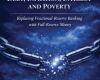
This is reply to the second rejoinder written by authors of the book “Breaking the Trap of Debt, Inflation, Interest and Poverty” while responding to the book review.


This is reply to the second rejoinder written by authors of the book “Breaking the Trap of Debt, Inflation, Interest and Poverty” while responding to the book review.

The book compares Islamic and conventional economics in response to economic crises, both across countries and financial institutions and provides a brief analysis of financial crises from a theoretical point of view, examining various approaches. It discusses how the Islamic financial system could serve to mitigate the occurrence of a financial crisis, since the prohibition of Riba, Maysir, and Gharar transactions offers a solution to financial crisis from speculative bubbles and crash. It also discusses some of the challenges facing the Islamic finance industry.

Global trade relations are tense and there is a risk of unpredictable and potentially sharp changes in trade policies worldwide. Geo-economics confrontation (sanctions, tariffs, investment screening) ranks #3 for current (2025) risks according to the GRPS and #9 over a two-year horizon. This comes after trade tensions have already been rising steeply since 2017. According to Global Trade Alert, the number of harmful new policy interventions per year rose globally from 600 in 2017 to over 3,000 in 2022, 2023, and 2024.

The author urges that deep and rapid decarbonization must become a global priority because climate tipping points will likely be reached much sooner than previously expected as greenhouse gas emissions continue to rise. To safeguard humanity and its societal systems, it is not only important to consider the time it takes to achieve decarbonization, but to ensure that we avoid reaching the climate tipping points.
Financing is crucial for achieving the Sustainable Development Goals (SDGs) because it enables countries to invest in the infrastructure, programs, and services necessary to achieve the goals. Without sufficient financing, countries may struggle to make progress towards the SDGs. The United Nations estimates that achieving the SDGs will require an additional $2.5 trillion in annual investment until 2030. Due to misaligned incentives, both public and private actors still invest in brown activities and have not yet fully aligned their decision-making and financing with the SDGs.
There is too much focus on efficiency, but equity is ignored and is left to politicians and policymakers. He admits that our recommendations become little more than a license for plunder. He mentions that economists have stopped thinking about ethics and human well-being.
On the social equality front, the one paying interest becomes a slave of those who lent him money since the burden gets bigger over time. This leads to dependency and leaves self-empowerment as mere fantasy and ultimately leads towards loss of self-identity, self-honor and destruction of humanity.

Islamic finance industry assets are now worth more than $2.6 trillion by 2019. The industry has shown resilience and double digit growth even in the face of global economic slowdown. After substantial double digit growth in assets, customer base and profits, Islamic banks are expected to embrace the vision to provide an egalitarian financial system which is inclusive for all and avoid the pitfalls which the conventional banking based on interest could not avoid.

The idea of material progress and well being enabling the people to forget fear and religion and Question of ‘why we exist’, has failed. Ignoring the purpose of existence and trying to replace it with material self pursuit does not and has not solved the fundamental human quest of ‘why we exist’.

Unrestrained chase of self-interest, moral relativism, incentive-led economic choices and indifference to collective responsibilities has led to engender societies where economic interests have become the solitary basis of establishing and maintaining relationships.

