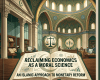
Prof. Zaman’s paper, ‘Reclaiming Economics as a Moral Science: An Islamic Approach to Monetary Reform’ argues that contemporary monetary reform remains incomplete because it concentrates on technical solutions – such as macro prudential regulation, institutional safeguards, and regulatory redesign – while insufficiently addressing justice and public welfare. He observes that Islamic finance has developed relatively sophisticated mechanisms for micro-level Shari’ah compliance but still lacks comparable institutional capability for governing systemic outcomes in accordance with the public interest. The paper therefore reframes monetary reform as a problem not only of technical design but also of moral governance.