

| Title: Economics of Muhammad PBUH (معیشت نبوی صلی اللہ علیہ وسلم) Author: Syed Fazl ur Rehman Publisher: Dar-ul-Ilm Wat-Tahqeeq |
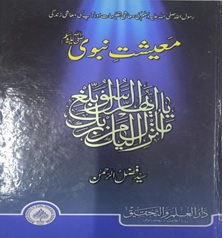
This book presents the personal finance management of Prophet Muhammad (PBUH) along with economic teachings. It provides details of both the periods, i.e. period of life spent in Makkah and period of life spent in Medina.
Prophet Muhammad (pbuh) lost both parents at an early age. Prophet Muhammad (pbuh) inherited some belongings from His late father. Besides that, He (pbuh) was supported by grandparent and then two uncles. It ensured that all physiological needs of Prophet Muhammad (pbuh) were met with convenience and ease in the early period of life.
Then, when Prophet Muhammad (pbuh) reached a mature age, He (pbuh) involved in herding and then trading. He (pbuh) learnt trading through His uncle and also accompanied him in trading visits. Then, Prophet Muhammad (pbuh) progressed and engaged as Mudarib in Mudarabah.
Prophet Muhammad (pbuh) did exceptionally well as a trading manager. People liked His honesty and professionalism.
It is narrated that once Prophet Muhammad (pbuh) sold a camel. But, upon recalling that the camel had a defect, He (pbuh) Himself returned the money. Once a person promised to pay Him (pbuh) and asked to wait at a particular place. But, the person forgot to pay back. When he realized that he had forgotten the commitment, he came back and found Prophet Muhammad (pbuh) there waiting for him since the last three days.
Despite enmity towards the message of Islam, people in Makkah despite all hostility and enmity trusted Prophet Muhammad (pbuh) to do safekeeping of their belongings. Even when faced with threats, Prophet Muhammad (pbuh) was most concerned about returning the belongings of the people to them and made conscious arrangement to ensure that people’s belongings are returned safely to them.
Prophet Muhammad (pbuh) also acted as Mudarib for Khadija (rta). Both later on got married. When Khadija (rta) died, Prophet Muhammad (pbuh) also got a share in inheritance.
In Medina, Prophet Muhammad (pbuh) was warmly welcomed. Often, he would be invited as guest with honour. People would feel honour if they get a chance to host Prophet Muhammad (pbuh) or send Him meals and gifts like clothes.
When battles started, Muslims started getting Amwal-e-Ghanimat. Prophet Muhammad (pbuh) also got His share. But, He (pbuh) would not use it all for Himself and family. Rather, He (pbuh) would distribute a major part of it to the needy.
In a nutshell, the picture that emerges from the authentic narrations is that Prophet Muhammad (pbuh) did not have to suffer from poverty or hunger. Occasional challenges were circumstantial. He (pbuh) had earned sustenance through trading. He (pbuh) also had livestock and in Medina, there were agricultural lands which will yield enough food for the whole family.
Prophet Muhammad (pbuh) had multiple forms of wealth including agricultural land, livestock and armor, to name a few. He was sufficiently able to meet His needs along with the needs of the family with ease. Prophet Muhammad (pbuh) had spent in charity all the time and this is only possible if He had been able to manage His personal finance without constraints.
Categories: General Issues About Islam
 Islamic Economics Project