

April 19, 2024 – SZABIST University Karachi together with its Faculty of Management Sciences, Faculty of Social Sciences, Faculty of Life Sciences and Faculty of Computer Sciences in collaboration with SZABIST University Larkana Campus, SZABIST University Hyderabad Campus and SZABIST University Gharo Campus hosted the Second International Conference on the Theme of Sustainability and Innovation.
Conference Patron and Vice President Academics, Prof. Dr. Altaf Mukati inaugurated the conference by welcoming international and national speakers and shedding light on how SZABIST is committed to the challenge of sustainability and fostering innovation.
Chancellor SZABIST University Dr. Azra Fazal highlighted the multi faceted challenges related to sustainability and disruptions caused by technological changes, climate changes and global socio-political changes which require a comprehensive, efficient and well coordinated response.
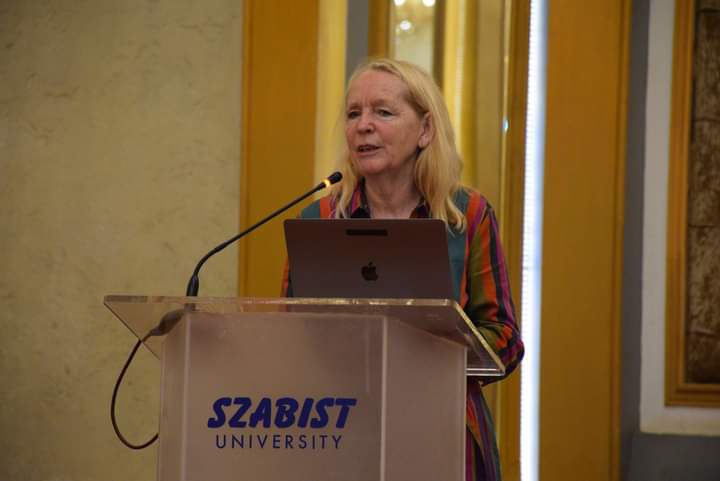
In the first keynote address of the conference, Assoc. Prof. Eva Roth from South Danish University highlighted that in meeting sustainability challenges, complacency must be avoided and planetary boundaries must be respected. Environment as public good needs careful management. She said that we also need to acknowledge that high inequality affects access to green technology as well. Consumer awareness is also important. They must avoid waste and dispose waste in a smart and efficient way.
For corporates, ESG reporting shall be mandatory like it is in some countries like Denmark. If necessary, degrowth is not bad if environmentally unfriendly production is reduced since protecting nature is necessary.
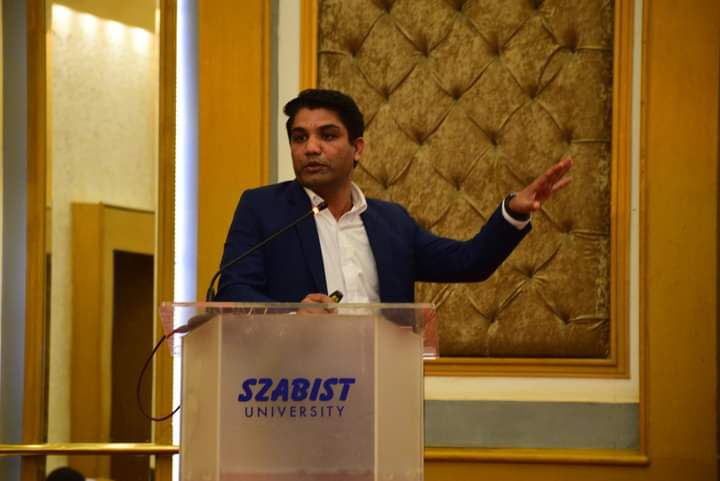
In the second keynote address of the conference, Dr. Prem Menghwar from University of Virginia emphasized that stakeholder theory and approach is necessary to adopt by corporations as they are expected to be catering to broader stakeholders than just emphasizing profit maximisation. Pursuit of profits can happen with solving societal problems and demands. Therefore, entrepreneurs and entrepreneurial culture needs to be cultivated rather than bashing businesses all the time. There is no need to undermine contribution of corporate sector. Large profitable corporations are good for economic growth as well as social investments.
The first panel discussion comprising of executive leadership included
Mr. Haroon Qasim, Managing Director, Pharmevo.
Mr. Syed Usman Qaiser, Head of Marketing and Brand Management, Jubilee Life Insurance.
Mr. Favad Soomro, Head of Engro Foundation.
Mr. Muhammad Saifullah, Communication and PR, Shell LiveWIRE Pakistan.
Mr. Arif Hussain Nomani, Group Senior General Manager HR & Admin, Ismail Industries.
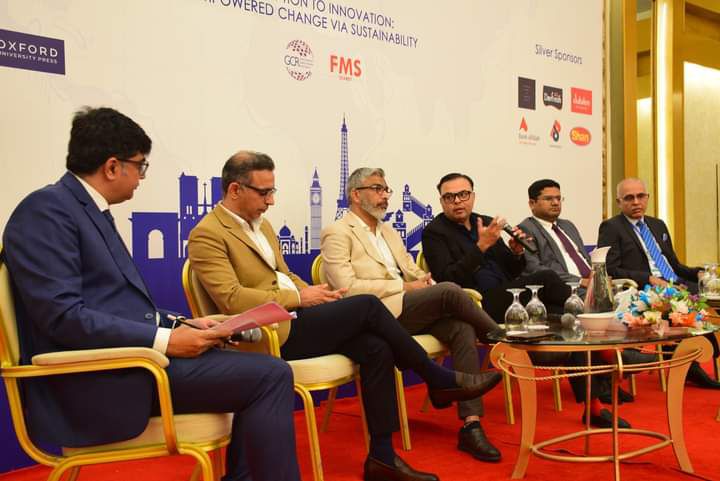
Expert panelists discussed and affirmed that corporate sector in Pakistan is doing various activities to contribute to SDGs. The panel discussion was moderated by Assoc. Prof. Dr. Shujaat Mubarak from Edinburgh Business School, UK.
Panelists admitted that focus is more on social and environmental sustainability through philanthropic drive and creating sustainable livelihoods. When financial outcomes are aligned with sustainability, intervention is easier. Challenge comes when companies need to spend resources, but there is no market or regulatory support.
The panelists lamented the fact that insurance business is Pakistan is not large enough even though there is huge need. It is because of low income, low savings, lack of documentation and complex tax system which encourages people to remain under the radar.
Furthermore, panelists highlighted the need for more research on sustainable materials so that production process, pricing and supply is not disrupted. Recycling and managing waste is important for both environment as well as cutting cost. Need to focus on low hanging fruits first. E.g. Paperless environment. Panelists said that offsetting environmental damage is corporate responsibility. Not only corporate organizations need to comply with SECP regulations, but also ESG reporting frameworks while exporting to the rest of the world without facing market exclusion.
In the other panel discussion at SZABIST University Second International Conference, experts from academia, such as Prof. Dr. Vali Uddin, Vice Chancellor, Sir Syed University and Vice President Prof. Dr. Altaf Mukati enlightened the conference participants on AI and its applications. Panelists from corporate sector Humayun Zafar, Enterprise Data Consultant , E&Y and Sohail Wajahat, Ex-Minister of Petroleum also shed light on how AI can benefit organisations and society.
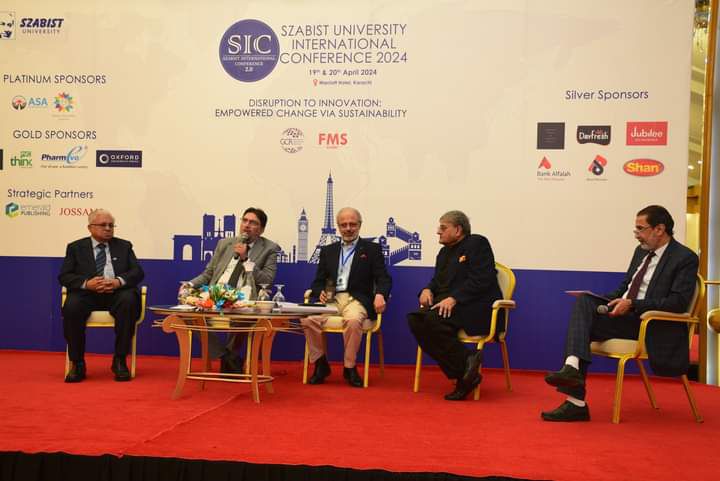
Panel experts discussed that people in Pakistan have exposure to AI, but we are still not fully utilizing it properly since there is a capability gap. There is still huge digital divide, tax exclusion and informal economy.
There are benefits of AI which can help in decision-making both for individuals as well as for organizations. Individuals benefit from applications like ChatGPT and the like to improve their writing, find programming codes and technical answers smartly. Driverless cars and other means of transport will further bring ease in the way we move.
On the other hand, organizations can use AI in transportation, advertising and data driven decision-making under uncertainty and risky situations. AI can also help in improving governance by government. But, in Pakistan, there is lack of regulatory impetus and even policy framework.
There is a risk aversion to the greater use of AI which requires creating awareness. Human intelligence is still needed. AI needs to be taken as complementary technology and as a tool rather than become dependent on it.
Pakistan needs to also focus on commercial value creation using AI and IT. India has more than $200 billion IT exports annually whereas Pakistan right now has $2 billion IT exports only. Role of education sector is important in plugging the capability gap.
The first day of conference also featured parallel track sessions in which shortlisted papers were presented in the area of management sciences, social sciences, and artificial intelligence.
Categories: Moral Reflections on Economics
 Islamic Economics Project