

On November 3 and 4, the Second International Conference on Islamic and Halal Economic Studies was held in Johor Bahru, Malaysia. It was jointly organized by Pertubuhan Legasi Tun Abdullah Ahmad Badawi, Universiti Kebangsaan Malaysia, Universiti Teknologi Malaysia, Ritsumeikan University, Japan, Kyoto University, Japan, Halal Development Corporation Berhad (HDC) and Jabatan Kemajuan Islam Malaysia (JAKIM).
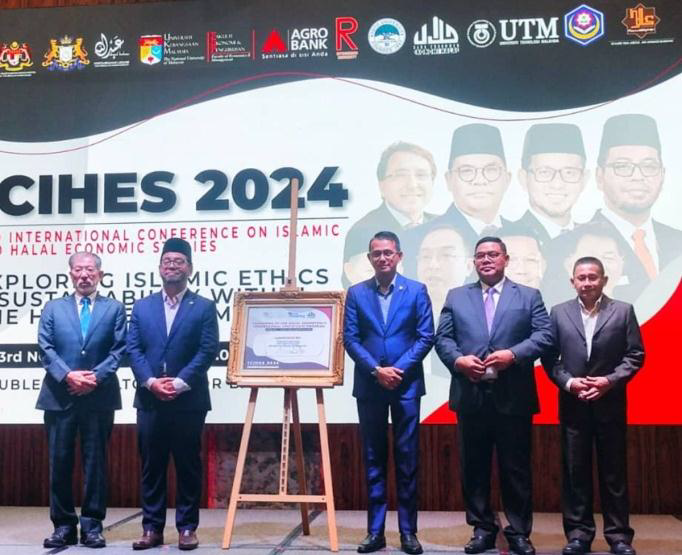
The conference kicked off with address by Deputy Minister of Religion in Malaysia. Dr. Zulkifli highlighted the importance of halal economy and how the current government in Malaysia is committed to provide an enabling environment for halal industry. He highlighted the schemes and initiatives taken to support the halal economy in Johor as well as in Malaysia.
In his keynote speech, Prof. Mehmet Asutay of Durham University, UK emphasized that halal industry shall keep in perspective the pitfalls in traditional economy and try to achieve inclusivity by focusing on extended stakeholders governance, environmental responsibility and collective social interest.
He urged that the collective social interest shall prevail in policy making rather than serving the markets and elites. He emphasized on inclusivity in the economic and financial system and cautioned against becoming another segment serving the elites in the capitalistic paradigm.
Agro Bank also partnered in the conference. Chief Strategy Officer, Agro Bank, Mohamad Taufik in his keynote speech highlighted how Agro Bank became a full-fledged Islamic financial institution and now providing financing to the agricultural sector in both the upstream and downstream using not only the traditional as well as equity based modes of financing.
He highlighted that Agro Bank has also shared its expertise with Central Bank of Pakistan and such collaborations can help the other countries in halal economy to benefit from shared expertise.
The growth of the halal business is steadily expanding on a national and worldwide scale. The growing interest of numerous countries in developing the halal industry indicates a promising future for this sector.
In recent decades, religious demand has driven the halal economy to become a distinct segment of the global supply chain.
The consumption pattern associated with halal products is not limited to Muslims alone but also encompasses all economic stakeholders. Non-Muslim consumers may also prefer halal products for sanitation, quality, hygiene, and safety reasons.
The conference aimed to provide a platform and opportunity for practitioners, scholars, researchers, academicians, graduate students, NGOs and others from all over the world to converge and be proactively engaged in intellectual discourse on halal economy discussion, to explore new ideas and present the latest research findings related to all issues on halal economy either locally or internationally, in relation to the current phenomena pervading the Muslim communities.
It was emphasized by the experts in panel discussion that the halal industry plays a crucial role in achieving the Sustainable Development Goals (SDGs), specifically in addressing poverty, and hunger, promoting healthy lives and well-being, fostering decent work and economic growth, as well as driving industry innovation and infrastructure development, and sustainable consumption and production. To achieve this, collaborations among various stakeholders are vital to accomplish the objectives of SDGs.
Experts urged that regulation and standardization is important, but capacity building, innovation and productivity are also important to thrive in the halal industry. Muslim majority countries including Malaysia have to focus on leading the regulation as well as the market through enhancing innovation, value addition, productivity, infrastructure and trade collaborations regionally and globally.
Prof. Kasogi Yasuhi of Ritsumeikan University, Japan highlighted that there are plenty of reasons why halal economy shall be embraced by all. Prof. Abdul Ghafar Ismail, Honorary Professor at University Kebangsaan Malaysia in his speech highlighted how halal economy can benefit Johor economy as it is one of the significant contributors to Malaysian economy and holds great potential as a port city.
The conference also exhibited the halal products and services provided by University Kebangsaan Malaysia and Universiti Teknologi Malaysia among others. There are exclusive services and capacity building programs offered by these two universities to increase awareness and acumen about halal regulation, halal testing and halal certifications.
During the panel discussions, experts also emphasized that there is need for trans-disciplinary research in halal studies involving, economists, lawyers, scientists along with sociologists and jurists.
It was discussed that halal economy includes halal markets as well as distributive institutions beyond markets. Such institutions play a crucial role in helping micro-enterprises and consumers to get their needs fulfilled in halal economy.
Experts also discussed that the term halal economy is more neutral, more inclusive and gives an opportunity for dialogue and shared vision. It also helps Islamic economy to portray its significance as the size of Islamic finance may still be less than 5% of global finance, but halal economy adds to traditional economy while leaving or replacing only a few segments in traditional economy. Thus, policy discussions and dialogue will be helpful while using the term halal economy as it is an embedded and commonly shared reality.
Nonetheless, the authors also cautioned that halal economy shall not be looked upon only as a market opportunity. It should strive to avoid the pitfalls and limitations of liberal market economy and contribute positively to the goals of inclusive, sustainable and sound environmental and economic governance and development.
The papers presented in parallel sessions focused on nexus between the concept of halal and sustainability and how the blending can help reach new market segments, foster collaborations and reduce apprehensions about Islam. The research papers discussed the following important elements in halal economy.
Consumers‘ attitudes and readiness towards halal products
Market segmentation analysis of halal markets
Search for new markets in halal economy
Regulatory aspects in halal products
Definitional aspects to refine and contrast the concepts of halal and Tayyab
Categories: Articles on Islamic Economics
 Islamic Economics Project