

Daron Acemoglu and James Robinson
Why Nations Fail by Prof. Darren Acemoglu and Prof. Robinson is an examination of the factors that contribute to the success or failure of nations. They argue that inclusive political and economic institutions lead to prosperity, while extractive institutions lead to poverty and failure.
The authors criticize the proponents of other theories explaining global inequality. For example, the geographical theory of Jeffrey Sachs and Jared Diamond, the theory of ignorance of the elites by Abhijit Banerjee and Esther Duflo, as well as various cultural theories, such as that of Max Weber about the influence of Protestant ethic on economic development.
Authors argue that a country‘s propensity to wealth or poverty is not simply based on its geography (compare Mexico and USA), culture (Christian USA vs. Christian South America) or knowledge base (which can be borrowed and taken up through IMF, WB and global development financial institutions, albeit with limited positive results in Africa and South Asia).
Many countries have been in stagnation for a long time, and then, at a certain point in time, began a rapid economic growth, although their geographical position did not change.
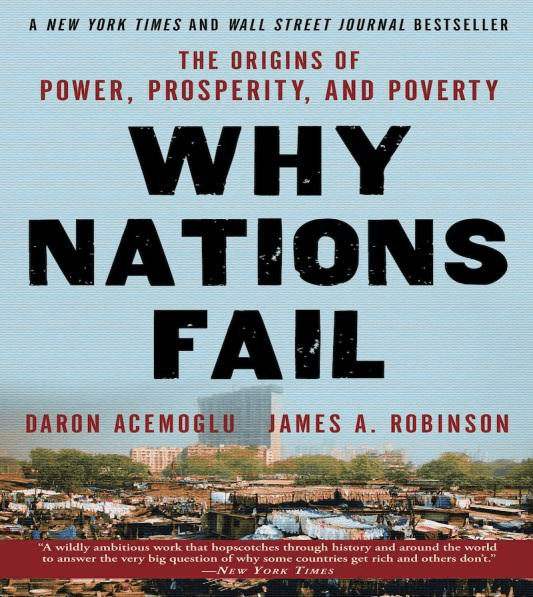
Authors argue that some nations are wealthier and more prosperous than others because of their political and economic institutions (e.g. government, market system). Good (inclusive) institutions enable investment and a sense of security in the government and the economic system and so nations prosper, but bad (extractive) institutions do not. Virtuous circles of innovation, expansion and peace are formed from inclusive institutions which form a cycle of increasing prosperity.
Prof. Acemoglu and Prof. Robinson argue that exclusionary policies designed to enrich the elites and exploit the poor majority have prevented technological innovation, as the existing elites fought tooth and nail against anything that might endanger their privileges.
In the eyes of the authors, it is inclusive political and economic institutions, which incentivize investment and innovation, through their protection of human and property rights that ultimately lead to the success of a nation. They draw upon a wide array of examples, such as differences in intellectual property rights, and the impact that this has had in prosperous nations whilst contrasting this with the lack of such rights in poorer nations.
Inclusive economic institutions protect the property rights of wide sections of society (not just the elite), they do not allow unjustified alienation of property, and they allow all citizens to participate in economic relations, in order to make a profit. Under the conditions of such institutions, workers are interested in increasing labour productivity. Nations, where individuals or corporate organizations find it difficult to loot the country‘s national treasury, they will find it easier to build a good economy.
Extractive economic institutions exclude large segments of the population from the distribution of income from their own activities. They prevent everyone, except the elite, from benefiting in economic relations, who, on the contrary, are allowed to even alienate the property of those who do not belong to the elite.
In the context of such institutions, workers have no incentive to increase labour productivity, since all or almost all of the additional income will be withdrawn by the elite. Such economic institutions are accompanied by extractive political institutions that exclude large sections of the population from governing the country and concentrate all political power in the hands of a narrow stratum of society (for example, the nobility).
Examples are absolute monarchies and various types of dictatorial and totalitarian regimes, as well as authoritarian regimes, with external elements of democracy (constitution and elections), which are so widespread in the modern world, where power is supported by power structures: the army, the police, and dependent courts.
The very fact that there are elections in a country does not mean that its institutions cannot be classified as extractive: competition can be dishonest, candidates‘ opportunities and their access to the media are unequal, and voting is conducted with numerous violations, and in this case the elections are just a spectacle, the ending of which is known, in advance.
Authors also discuss China’s economic boom, attributing it to increasingly inclusive economic policies. According to Acemoglu and Robinson, economic growth can lead to changes in political institutions. They caution that if China does not improve its political balance, it may face a collapse similar to the Soviet Union in the 1990s.
Political institutions, like a constitution, determine the written distribution of political power, while the distribution of economic resources determines the actual distribution of political power.
Both the written and actual distribution of political power impact economic institutions and how production is conducted. They also shape future political institutions. Economic institutions also determine the distribution of resources for the future. This framework is time-dependent, as today’s institutions determine tomorrow‘s economic growth and institutions.
Some critics think that the book fails to explain the recent economic development in China and India.
China, under an authoritarian regime, has achieved rapid economic growth, while democratic India has lagged behind. This challenges the book‘s theory of inclusive and extractive political institutions. Several examples in Asia, including Singapore and South Korea, easily refute argument that democratic political institutions are prerequisites for economic growth.
The authors believe that political inclusiveness must come first, before growth is achievable. Yet, most examples of economic growth in the last 50 years—the Asian miracles of Hong Kong, Korea, Taiwan, and Singapore—took place when their political system tended more toward exclusiveness.
The authors point out that political institutions create economic ones, so true economic change starts with political change. This means that a country has to adopt inclusive practices in order to achieve meaningful economic growth. However, the case study of China tells a different picture.
Peter Forbes also argues that politically inclusive countries at home may still have extractive elements—for instance, the existence of a shadow banking system, of conglomerate manufacturers. He warns against extractive practices, under the guise of an inclusive economy.
Critics also argue that there is insufficient appreciation in the book that inclusive domestic institutions can be supported by extractive ones abroad. Colonists enjoyed economic benefits from colonies. Extractive institutions abroad could support the growth of inclusive institutions domestically.
From an Islamic economics perspective, the authors undermine that inclusive institutions may foster growth, but exacerbate inequality. Growing inequalities then undermine shallow claims of inclusivity and can make democracies also serving elite dominance. Crony capitalism is an example.
Therefore, inclusivity of opportunities in law is one thing, but having an equitable distribution of income and wealth for equality of opportunities and fair start are different things altogether.
Furthermore, inclusive institutions within nation states still are not able to boost commitment towards wider goals of global peace, justice and environmental sustainability. Even the most so called inclusive nation states are complicit in crimes against humanity across borders and chief contributors to the environmental and economic injustice with future generations of their own domestic lands.
Islamic economics promotes inclusive institutions and checks extractive institutions through its norms and teachings about justice, fairness, honesty, accountability and transparency. It highlights the worldview which gives objective morality, deterministic incentives and reward system in two-worldly view of life and reduces tension between nation states, between current versus future generations and between human versus other species.
Islamic economics presents the custodian model rather than anthropogenic view of world and life. The objective and universal morality given by Islam can bring about shared prosperity not only of few, but all human nations, not just current, but future generations and not just human, but other species as well.
Islamic economics compliments market mechanism with beyond market institutions to check inequality by wealth transfers from rich to the poor in Zakat and by building social safety nets as perpetual common property resources to reduce private concentration of wealth through Waqf.
Lastly, the inheritance distribution ensures that there is one to many‘ transfer of inherited wealth in each generation from each unit of the household.
Categories: Articles on Islamic Economics, Socio-Political Issues
 Islamic Economics Project