

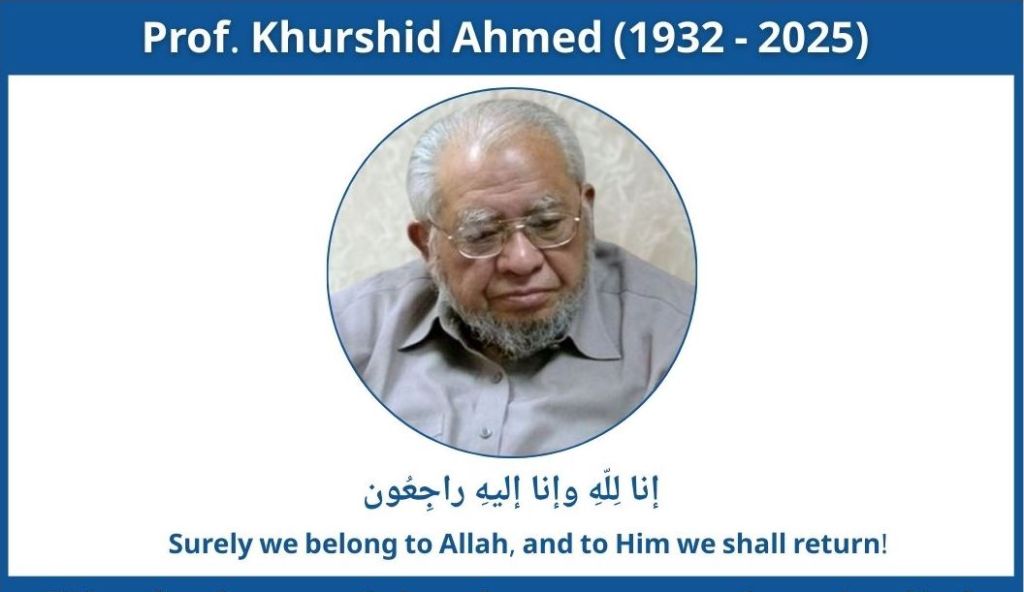
Prof. Khurshid Ahmad passed away on April 13, 2025 at the age of 93 years in Leicester, UK. He was born on March 23, 1932 in Delhi. He was a renowned scholar, academic, economist, prolific writer, policymaker and legislator.
He was the founder of one of the oldest think tanks in Pakistan which has produced tremendous literature on policy issues ever since 1979. He was one of the prolific and pioneer writers in the contemporary Islamic economics ever since the 1970s. He was also the co-founder of the Islamic Foundation in Leicester, UK established in 1973. The Foundation became a beacon of intellectual activity, fostering more profound understanding of Islam in the West and contributing significantly to the development of British Muslim identity and thought.
He was awarded Islamic Development Bank award in 1988. He was also recipient of King Faisal International Prize in 1990. LaRiba in USA awarded him the LaRiba prize for his works in interest-free economy and finance in 1998. IKAM awarded him lifetime achievement award for his works in Islamic Economics in 2022. He also received Pakistan’s highest civilian award Nishan-e-Imtiaz in 2011.
He served as Federal Minister for Planning, Development & Statistics in 1978. He also worked as Deputy Chairman of Planning Commission in Pakistan looking after the Islamization of the economy during 1978-79. As Deputy Chairman of the Planning Commission, he worked to integrate Islamic principles into Pakistan’s economic and policy frameworks. He also served as Chairman, Senate Standing Committee on Finance, Economic Affairs & Planning during his time as Senator in Pakistan.
He served in the Senate of Pakistan for a number of years. During his tenure as a Senator until 2012, he provided erudite policy advice in a well-researched and well-articulated way. Those speeches in the Senate were so visionary, comprehensive and timeless that they were compiled in a book and published by Institute of Policy Studies. He put forward his serious suggestions with facts and figures in an objective way. Usually, in such speeches, politics and short sightedness is exhibited in order to compete against the political opposition. However, quite refreshingly, his way of delivering speech shows the proper conduct and demeanour in highlighting the key issues and challenges, pinpointing problems and suggesting concrete steps to resolve the problems.
At the age of 17 years, he published his first English article in the Muslim Economist. He secured his graduation in BA in first-class honours in Economics in 1952. He obtained MSc with Honours in Economics after defending his thesis that contained the fundamental work of Adam Smith on invisible hand and the Capitalism in 1958.
In 1962, He graduated with an MA with Honours in Islamic studies from the University of Karachi. In 1970, his services to promote literacy was recognized by Leicester University, which honoured him with an honorary doctorate in Education. He also wrote books on principles of education and philosophy of education. In 1970, he joined the Department of Philosophy to teach Contemporary Philosophy at Leicester University. He was also awarded honorary doctorate degrees in Education by University of Malaysia (1982), in Literature by Loughborough University UK (2003) and in Islamic Economics by University of Malaysia (2006).
In academic administration, he served as Advisor, King Abdul Aziz University Jeddah, Saudi Arabia during 1976–1983 and Member, Supreme Advisory Council, International Centre for Research in Islamic Economics, King Abdul Aziz University, Jeddah, Saudi Arabia during 1979-1983. He also worked as Chairman, International Institute of Islamic Economics, International Islamic University Islamabad, Pakistan during 1983-1987. He also served as Vice Chancellor of Pakistan Institute of Development Economics and Rector, Markfield Institute of Higher Education, UK.
He wrote eloquently on interfaith dialogue and allayed the apprehensions about Islam in the West. He was Vice-President, Standing Conference on Jews, Christians & Muslims in Europe, Berlin and London, U.K. from 1974 to 1978. He was also Co-Chairman, Christian-Muslim Dialogue Chembasey, Switzerland in 1976. He was also Member, Advisory Council, Centre for the Study of Islam & Christian- Muslim Relations, Selly Oak Colleges, Birmingham, U.K. from 1976 to 1978. He was also Member of Royal Academy for Islamic Civilization Amman, Jordan and Board of Trustees of Islamic Centre in Zaria, Nigeria.
He wrote books on explaining the message of Islam, Qur’an and Prophet Muhammad (pbuh) including such works as ‘Islam: Its Meaning and Message’ (1975) and ‘The Qur’an: Basic Teachings’ (1979). He also wrote books on ‘Fanaticism, Intolerance and Islam’ (1956), ‘Islam and the West’ (1958), ‘Position of Women in Islam’ (1967) and ‘Family Life in Islam’ (1974).
Professor Khurshid Ahmad was a towering intellectual, a visionary Islamic economist, and a principled thought leader whose influence extended across continents. He was also author of more than 70 books in English and Urdu languages. He was also Editor of monthly ‘Tarjuman-ul-Qur’an’. He translated and edited several books written by Syed Abul-Ala-Mawdudi meticulously by transcribing lectures and speeches. He was to Maulana Mawdudi what Engel was to Marx. Reading him gave one the experience of reading Maulana Mawdudi.
His writings and initiatives helped shape modern Islamic economic theory and inspired countless students, academics, and activists globally. His writing was lucid, scholarly, visionary and exhibited his breadth of reading, intellectual insights, clarity of thoughts and passion for meaningful change.
In Islamic economics, he wrote several books, book chapters and research papers. He explained the distinction of Islamic economics vis-à-vis Socialism and Capitalism. Some of his important works in Islamic economics include:
- Studies in Islamic Economics, (Editor & Contributor, Leicester, Islamic Foundation, 1980, 1981,1982, 1986).
- Towards Monetary and Fiscal System of Islam, Islamabad, Institute of Policy Studies, 1981.
- Economic Development in an Islamic Framework, Leicester, The Islamic Foundation, 1979.
- Islamic Approach to Development: Some Policy Implications, Institute of Policy Studies, Islamabad, 1994.
- The Contemporary Economic Challenges and Islam, Institute of Policy Studies, Islamabad, 2002.
His books had been translated in multiple languages including Arabic, French, Turkish, Bengali, Japanese, German, Indonesian, Hindi, Chinese, Korean, Persian, and others. Several PhD Thesis and Post-Doctoral works had highlighted and illustrated his vast contributions in East and the West. His passing marks the end of an era, but his legacy of scholarship, activism, and dedication to Islamic values will continue to inspire future generations. May Allah Almighty accept his lifelong service to the Ummah, elevate his ranks in Jannah, and grant his family and loved ones strength during this difficult time.
Categories: Articles on Islamic Economics, Socio-Political Issues
 Islamic Economics Project