

Reviewed by Salman Ahmed Shaikh
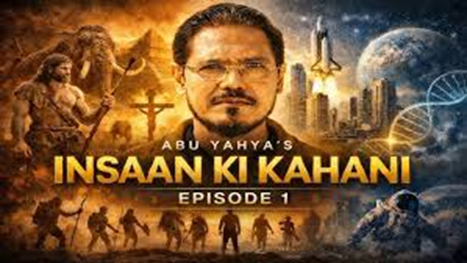
‘Insaan Ki Kahani’ (انسان کی کہانی) translated as ‘The Story of Humans’ is a documentary series created by Dr. Rehan Ahmed Yousufi, who is also known with the pen name Abu Yahya. The author is a learned scholar and penned many books on Islam, character building, social reforms and highlighting the moral issues in a Muslim culture, especially in Pakistan where he currently lives. In February and March 2026, the season two of the documentary was released and televised on licensed TV channels and YouTube channel of Inzaar educational trust.
The author had written academic books contributing scholarly to the theory of civilizational decline and Islam’s position on human slavery, both at the individual level and collective level in the form of dynastic and authoritarian rule. In his later part of life, the author has shown a sublime way of writing which emphasizes the moral conduct in personal and social choices.
With both an inclination as well as proficiency in literary writings, the author has produced life-changing novels in Urdu which have been translated in English as well. These novels are not only a unique addition to the propagation of Tawheed, but also are a unique addition to Urdu literature where the genre of novel is limited to romantic and thriller storytelling.
In his regular writings, the author uses short and crisp inspiring articles often written in one-page length. These articles present reflections from everyday events, travel, exploration and developments in the world in the field of science, technology, society and politics.
In the second and the final season of this documentary, the author uses the medium of storytelling together with discussions among him and the knowledge seekers. The language is easy to understand, the choreography is excellent and the delivery is illuminating and thought provoking. Unlike the other religious documentaries, this documentary does not attempt to merely create sensation and telling unprovable prophecies about the end of times and the fate of this world.
The information presented in the documentary is rooted in the Qur’an, the last authentic word of God available on this earth till the end of times. The documentary presents the Islamic worldview from the Qur’an itself. In this season, the Islamic worldview and shared common history is traced back from the other scriptures as well including Old Testament and New Testament.
During the questions and answers between him and the audience, the author removes misconceptions about Islam and also exposes the limitations of mere naturalistic explanation of material phenomena around us.
The author presents the authentic scientific details about the fine tuning of life and the presence of mathematical regularity in the natural processes. In this way, the author proves that the scientific discoveries had only proven that the fine tuning is more complex and precise than as understood before. Hence, science does not present or support the case to replace the concept of Tawheed. The documentary explains how polytheism is a discredit to the Creator without evidence from science, rationality and the revealed knowledge.
The author does not remain glued to discussing the witty philosophical arguments and scientific signs for the existence of God. The author goes on to also prove the authenticity of the Qur’an as the word of Allah and prophet Muhammad (pbuh) as the last messenger of Allah through historical, logical and rational arguments.
The author clarifies that the Islamic worldview does not start with the teachings of the last messenger. The purpose of life defined for humans is explained to all the human societies that have lived on earth.
The last season of the documentary outlines the details of how all the messengers came with the call for believing in oneness of Allah and accountability in afterlife. The direct recipient nations of the Rasool faced divine accountability in this world as well. When these nations rejected the messengers sent as Rasool and after the truth had been proved and established in irrefutable ways, the deniers in those nations were punished in this world as well.
Qur’an gives account of many such nations. To the direct recipients of the Qur’an which included the polytheists of Arabia, Christians and Jews, these accounts were just a mere reference to the authentic history they already knew. They could not provide any counter-factual details of those historical references. They perfectly knew that what is being referred is indeed true.
In the case of the last messenger Prophet Muhammad (pbuh), this divine appraisal became part of the authentic record of the history of the entire world as well. Telling that story has significance for the humans of today. All the humans are in the same trial and will face afterlife accountability in the life hereafter.
The details of the past history in the documentary focuses more on the reasons why some people were rewarded and some were punished. What were the exact shortcomings which resulted in Allah’s disapproval? What was the nature of the evidence provided by the messengers? The nations of the Rasool received ample evidence similar to performing an experiment where the results follow a particular predicted course.
Along the way of narrating the stories of the various nations, the documentary provides compelling answers to solve the problem of evil, confusion about simultaneous functioning of God’s attributes and the balance between predetermined fate and free will.
The documentary is not meant to just merely provide the history of ‘others’ with a historical account of the past. The documentary is meant to arouse introspection and alert the humans to not ignore their origins and ultimate fate. It is aimed to explore the ultimate meaning of life and prepare for afterlife accountability where absolute justice is going to be established.
The documentary presents historic and scientific information that is easy to understand and taken from authentic and established sources. Instead of over-arguing the case for religion from science and unproven archaeology and historical records, it limits the attention to focus on Qur’an, established scientific facts, established archaeological evidence and universally well-established historical records. In essence, it seeks to bridge the gap between faith and reason, presenting Islamic teachings in a modern and engaging way.
The documentary is titled appropriately. It is not the story of Muslims, but the story of humans. In presenting the Islamic worldview, it explains that Tawheed is the basis of all divine religions. Tawheed-based worldview not only unites every sect within Islam, but also transcends and encompasses all monotheistic religions including Judaism and Christianity.
The documentary differentiates between our animalistic essence and spirituality, highlighting the importance of understanding these elements in shaping our moral and ethical framework. Humans have been given a level of authority on earth, and that authority should be used with moral responsibility that comes with human authority.
It explains that humans are just a guest in this universe. A guest that has arrived in the universe just now. A guest who is well served like no other. A guest who is not only served by the host, but by others as well in the universe. Yet, if a human, as a guest, does not acknowledge and thank the Creator, then it is an immoral attitude.
In the last episode, the author focuses on the future of humans. Irrespective of the technological advancements and political upheavals, this worldly life for each human and for each nation will end one day. Lasting success and contentment depends on righteous actions which are not limited by predetermined fate, political disadvantages and material limitations. The lesson and key take away is to remember the origins, purpose and the journey ahead to face the afterlife accountability. This documentary invigorates the mind to not lose this picture amidst the affairs in life.
The documentary is available with English subtitles on the You tube channel of Inzaar. It is highly recommended to watch the 30 episodes and also arrange collective viewership in schools and colleges. Besides religion, those interested in science, history, philosophy, archaeology, travel and cultures would also find it very interesting. Link of the episodes is given here: Insaan Ki Kahani.
Categories: Articles on Islamic Economics, Science and Religion
 Islamic Economics Project