

Haslina Ibrahim
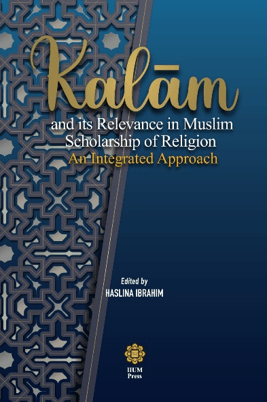
“Kalam and Its Relevance in Muslim Scholarship of Religion: An Integrated Approach” (edited by Haslina Ibrahim, IIUM Press,
2023) reclaims classical Islamic theology (Kalam) as a vital framework for contemporary comparative religion. The edited volume critiques dominant Western academic paradigms while establishing a principled model for interfaith discourse.
The book addresses a central methodological tension in religious studies: the demand for epoché, or the suspension of personal belief. Prof. Haslina Ibrahim argues that ‘value-free’ neutrality leads to methodological sterility.
Asking scholars to detach from their worldview strips inquiry of purpose; instead, the Kalam tradition treats theological commitment as a foundation for rigorous rational inquiry, compelling scholars to actively evaluate truth (haqq) and falsehood (batil) rather than remaining passively neutral.
To understand religion in its own right and perspective, it is not useful to have a completely neutral stance. Moreover, understanding religion from a piecemeal approach using philosophy, sociology, history, philology and phenomenology is not sufficient to understand the core contents of the religion. This is especially critical for divine religions which have a transcendent source.
Often, the Western perspective utilizes the neutral, scientific and compartmentalized method to study religion. Then, what it is able to study is the culture that emanates from the religion, the society that emerges from religion, the people who uphold religion, but not the Creator and core message and purpose of religion as spelled out in the primary texts.
When those texts are read comparatively with the presumption that the divine books are authored by some humans, some Atheists argue that there is repetition or plagiarism. This misunderstanding can be removed if one takes the perspective that the author of these divine books is not human or humans.
Rather, the message in these books is by one source and the message of Tawheed is the cornerstone of monotheistic religions. This way, religions can be better understood and compared rather than taking a neutral stance and ignoring the core contents of religion altogether.
The book also explores how early mutakallimūn (theologians) pioneered comparative studies through genres like al-Milal wa al-Nihal (religions and sects). Classical figures such as Al-Biruni, Ibn Hazm, and Al-Shahrastani demonstrate that historical Kalam engaged other traditions with empirical rigor and deep intellectual curiosity rather than mere polemical hostility.
Classical mutakallimūn (theologians) engaged non-Muslim doctrines using reason-based, conviction-anchored frameworks rather than pretending neutral disbelief. The book demonstrates that Kalam is not merely defensive polemics, but a proactive tool for ethical interreligious dialogue rooted in scripture.
The use of Kalam is quite relevant to increase engagement, dialogue and communication. What is also important is to keep the premises fact-based and cognizant of valid and proven facts. That is where, science can serve the need of verification of premises which can be studied using the scientific method. However, the Kalam as a method of inquiry and comparative study would also embed logic and rationality. The authors discuss that the use of Kalam is encouraged by the general theme of Qur’an.
Nonetheless, the use of Kalam as a method and the past use of Kalam in historical discourses are two separate things. Some scholars may have done mistakes in using Kalam in matters where direct guidance is not possible or is unambiguously provided by Qur’an.
The use of Kalam as a method of engaging with religion holistically is still important. Through concepts such as ḥiwār (constructive dialogue) and jadal (dialectical engagement), the authors reframe Kalam. It shifts the discipline from a purely defensive stance into a proactive tool for ethical, respectful interreligious engagement.
The book rejects the idea that dialogue requires flattening conviction into universal relativism. Authentic engagement occurs when scholars remain firmly grounded in their theological principles while engaging other faith traditions with fairness and empathy.
By bridging classical Uṣūl al-Dīn (foundations of religion) with modern academic methodologies, the contributors offer a roadmap for scholars navigating Western-dominated academia. The work restores Kalam as a living, adaptable methodology capable of addressing pluralism and fostering coexistence in a modern context.
Dr. Nur Farhana Abdul Rahman and Prof. Haslina Ibrahim examine Ismail Raji al-Faruqi’s concept of Meta-Religion as a modern extension of Kalam. It provides a third way between dogmatic exclusivism and postmodern relativism. Al-Faruqi’s formulation of universal rational criteria (grounded in Islamic metaphysics like unitarianism and logical consistency) used to evaluate religious claims on a shared, objective platform. Al-Faruqi established universal axioms to evaluate any tradition: The Law of Non-Contradiction (truth cannot contradict itself), Correspondence with Reality (doctrines must align with empirical facts and human nature), and Practical Moral Utility (faith must lead to ethical flourishing).
One of the theme in the book is to communicate the contents of religion at the grassroots. That is where, it is also important to create direct engagement with Qur’an. Qur’an itself has its own rational, logical and fact-based way of proving the religious beliefs. Therefore, the religious beliefs can be presented as justified true belief in the light of rational arguments, logical arguments, moral arguments and scientific arguments to strengthen certain premises. Kalam as a method of study and discourse has the ability to integrate revealed knowledge and provide a useful way of dialogue universally.
The message one derives from the book is that the focus should be on seeking truth rather than just assembling viewpoints or finding the human-centred reasons behind the viewpoints. Passive post-modern relativism or secular neutrality is not beneficial for seeking truth actively and openly. It is important to study other faith traditions using primary sources and rigorous textual context. Furthermore, it is pertinent to use shared rational criteria (‘aql) to contrast doctrines.
Using the Qur’anic methodology, Muslims are commanded to invite the People of the Book (Ahl al-Kitāb) to a ‘common word’ (the worship of God alone). This illustrates starting dialogue on shared monotheistic and rational ground before addressing core theological divergences. The book mentions Prophet Muhammad’s engagement with the Christian delegation of Najran in Medina. The Prophet hosted them in his mosque and permitted them to conduct their prayer rites while engaging in deep, uncompromised theological debate about the nature of Christ, demonstrating that firm doctrinal disagreement coexists with hospitality and respect.
Categories: Science and Religion

