

| Title: Islam and Economic Security (اسلام اور معاشی تحفظ) Author: Allama Yousuf ul Qaradawi Publisher: Al Badar Publications |
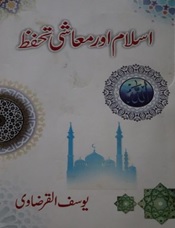
In this book, the respected scholar Allama Yousuf al Qaradawi explains how Islamic teachings related to economics ensure economic and distributive justice.
The Islamic teachings encourage striving for Halal means of earning as long as the other duties, such as worship to Allah are performed (Al-Jumuah: 10) and impermissible means and ways of earning are avoided, such as interest (Al-Baqarah: 276), bribery (Al-Baqarah: 188), fraud (Al-Mutaffifeen: 1-4), gambling (Al-Maida: 90), theft (Al-Maida: 38), business of intoxicants (Al-Maida: 90) and prostitution (Al-Nur:19), for instance.
In general, barring the above exceptions, the Qur’an allows mutually beneficial and consensual exchange (Al-Nisa: 29). As per Islamic texts, endowments bestowed by Allah are to be used for material goods as well as for societal causes to earn Falah (well-being in both worlds). Prophet (pbuh) said: “The truthful and trustworthy businessman will be in the company of Prophets, saints and martyrs on the Day of Judgment.” (Jami-al-Tirmizi, Chapter on Business).
Islam discourages idleness, dependency and unnecessary exit from the labour force. Prophet Muhammad (pbuh) said: “For one of you to go out early to gather firewood and carry it on his back so that he can give charity from it and be free of need from the people, is better for him than to ask a man who may give that to him or refuse. Indeed, the upper hand (giving) is more virtuous than the lower hand (receiving), and begin with (those who are) your dependants.” (Jami-at-Tirmidhi, Chapters on Zakat).
In another Hadith, Prophet Muhammad (pbuh) explained: “The upper hand is better than the lower hand, and the upper hand is the one that spends, and the lower hand is the one that asks.” (Sunan Abu Daud, Book of Zakat). Prophet Muhammad (pbuh) said that begging is not lawful for the rich and physically fit except for the one who is severely poor or in perilous debt (Jami-at-Tirmidhi, Chapters on Zakat).
Endowment inequality and relative abundance of one or the other type of resource in this world among people does not provide any basis of superiority in Islamic social framework. It is only meant to test thankfulness, patience and fairness in interpersonal and socio-economic relations.
Qur’an says: “Is it they who would portion out the Mercy of your Lord? It is We Who portion out between them their livelihood in this world, and We raised some of them above others in ranks, so that some may employ others in their work. But the Mercy (Paradise) of your Lord (O Muhammad – PBUH) is better than the (wealth of this world) which they amass.” (Al Zukhruf: 32)
Qur’an says: “And strain not your eyes in longing for the things We have given for enjoyment to various groups of them, the splendour of the life of this world that We may test them thereby. But the provision (good reward in the Hereafter) of your Lord is better and more lasting.” (Taha: 131).
Islam allows trade, but cautions against unfairness, exploitation and deceit. Qur’an says: “Do not devour one another’s property wrongfully, nor throw it before the judges in order to devour a portion of other’s property sinfully and knowingly.” (Al-Baqarah: 188). In another place, Qur’an says: “Do not devour another’s property wrongfully – unless it be by trade based on mutual consent.” (Al-Nisa: 29)
Islamic teachings related to commerce also strongly recommend fairness in trade dealings. Qur’an says: “And measure full when you measure. And weigh with an even balance. This is better and its end is good.” (Al-Bani-Israel: 35). In another place, Qur’an says: “Woe to those that deal in fraud, those who, when they have to receive by measure from men, exact full measure, but, when they have to give by measure or weight to men, give less than due. Do they not think that they will be called to account?” (Al-Mutaffifin: 1-4). Furthermore, Islam also emphasizes on fulfilling contractual obligations in mutual exchange. Qur’an says: “O you who believe! Fulfil [your] obligations”. (Al-Maida: 1)
Islam allows profit motive and using the profits for consumption and further investment. However, it discourages accumulation for the purpose of hoarding. Qur’an says: “They who hoard up gold and silver and spend it not in the way of Allah, unto them give tidings (O Muhammad) of a painful doom.” (Al-Tauba: 34).
Islamic teachings related to commerce denounce taking oaths for deceiving others. Qur’an says: “You resort to oaths as instruments of mutual deceit, so that a person might take greater advantage than another; although, Allah puts you to the test through this. Surely, on the Day of Resurrection, He will make clear the truth concerning the matters over which you differed.” (Al-Nahl: 94).
In commercial undertakings, Islam encourages documenting the terms of the agreement to mitigate the risk of moral hazard. Qur’an says: “O Believers! Whenever you lend money for a particular period, write and someone among you must write it justly. And the one who can write must not refuse.” (Al-Baqarah: 282).
Islamic principles of trade allow credit transactions and debts but condemn defaulting on loans. Prophet Muhammad (pbuh) said: “Any who takes out a loan, having resolved not to pay it back, will meet Allah as a thief.” (Sunan Ibn-e-Maja, Chapters on Charity).
Islamic principles of trade allow mutual bargaining to achieve the best result for oneself but recommend gentleness and softness in executing deals so as to avoid the zero-sum game and undue advantage. Prophet Muhammad (pbuh) said: “May Allah’s mercy be on him who is lenient in his buying, selling, and in demanding back his money [or debts].” (Sahih Bukhari, Book of Sales).
In selling goods, it is highly recommended that deceit is avoided in making and selling of products. Prophet Muhammad (pbuh) said: “It is not permissible for a Muslim to sell his brother goods in which there is a defect without pointing that out to him.” (Sunan Ibn-e-Maja, Chapter on Business Transactions).
In another Hadith, Prophet Muhammad (pbuh) said: “The seller and the buyer have the right to keep or return the goods as long as they have not parted or till they part; and if both the parties spoke the truth and described the defects and qualities [of the goods], then they would be blessed in their transaction, and if they told lies or hid something, then the blessings of their transaction would be lost.” (Sahih Bukhari, Book of Sales).
Deceit in contracts to get an unfair advantage is strongly condemned in Islam. Prophet Muhammad (pbuh) said: “Whoever takes a false oath to deprive somebody of his property will meet Allah while He will be angry with him.” (Sahih Bukhari, Book of Watering).
Islam encourages the price discovery process to be natural and without any frictions and hindrances. To ensure that price is determined competitively without information asymmetries, Prophet Muhammad (pbuh) forbade a town dweller to sell on behalf of a Bedouin and to artificially inflate prices (Sahih Muslim, Book of Marriage). Prophet Muhammad (pbuh) forbade intercepting traders until they reach the markets with their goods. (Sahih Muslim, Book of Financial Transactions). Furthermore, in bidding for goods, assets or businesses, overbidding without having a genuine intention to buy (Al-Najash) is prohibited.
Speculative trades inflate prices and lead to artificial price bubbles and crises when these bubbles burst. To foster genuineness of trades and diminish the speculative motives, Prophet Muhammad (pbuh) said: “He who buys food grain should not sell it until he has taken possession of it.” (Sahih Muslim, Book of Financial Transactions)
In labour management and relations, Islam, unlike capitalism, gives due protection and credit to labour. To highlight the importance of fair treatment of labour, Prophet Muhammad (pbuh) said: “I will be a foe to three persons on the Last Day: one of them being the one who, when he employs a person that has accomplished his duty, does not give him his due.” (Sahih Bukhari, Book of Hiring, Hadith Number 2270).
On timely remuneration to labour, Prophet Muhammad (pbuh) said: “Give the labour his wage before his sweat dries” (Sunan Ibn-e-Maja, Book of Pawning).
In another Hadith, Prophet Muhammad (pbuh) said: “Those are your brothers [workers under you] who are around you; Allah has placed them under you. So, if anyone of you has someone under him, he should feed him out of what he himself eats, clothe him like what he himself puts on, and let him not put so much burden on him that he is not able to bear, [and if that be the case], then lend your help to him.” (Sahih Bukhari, Book of Manumission).
Islamic social and moral teachings emphasize on showing kindness, generosity and benevolence to the fellow human beings. Allah says in Qur’an: “… Do good to parents, kinsfolk, orphans, Al-Masakin (the poor), the neighbour who is near to kin, the neighbour who is a stranger, the companion by your side and the wayfarer (you meet) …” (Al-Nisa: 36).
Qur’an says in another place: “So give to the kindred his due, and to Al-Miskin (the poor) and to the wayfarer…” (Ar-Rum: 38). Feeding orphans and poor is regarded as highly virtuous acts (Al-Balad: 12-16) in Qur’an.
Qur’an exhorts Muslims to look after orphans and treat them with kindness and generosity (Al-Fajr: 17-20), work honestly in their property (Al-Baqarah: 220) and avoid oppressive treatment (Al-Dhuha: 9) as well as refrain from harsh behaviour (Al-Maoon: 2). Qur’an strictly prohibits usurping the endowments of orphans (Al-Nisa: 2).
Prophet Muhammad (pbuh) declared that the best charity is to spend (in charity) while you are healthy, aspiring, hoping to survive, and fearing poverty, and not delaying until death comes to you (Sunan Abu Daud, Book of Wills). Allah wants the believers to avoid miserliness (Al-Nisa: 37). Instead of enjoining miserliness, Islam urges Muslims to help one another in good acts and endeavours (Al-Maida: 2).
Since Islam only accepts pure altruism, it promises numerous incentives for it in its two-worldly view of life. Several verses in Qur’an promise due reward for pure altruism (Al-Tauba: 121; Fatir: 29; Al-Hadid: 7).
In several other verses, spending in charitable ways for the sake of Allah is compared to a good loan which Allah will repay with a manifold increase (Al-Hadid: 11; Al-Hadid 18; Al-Taghabun: 17; Al-Muzzammil: 20). In several Ahadith also, Muslims are encouraged to spend so that Allah also spends on them with His blessings (Al-Bukhari, Book of Commentary).
Islam does not recognize impure altruism to satisfy ego and to achieve fame and recognition (Al-Baqarah: 264; Al-Maoon: 6). Prophet Muhammad (pbuh) advised anonymity and secrecy in charitable giving such that the right hand does not know what the left hand is giving (Al-Muslim, Book of Zakat).
Allah says of the ideal believers in Qur’an: “And they give food, in spite of their love for it to Miskin (poor), the orphan, and the captive. (Saying): ‘We feed you seeking Allah’s countenance only. We wish for no reward, nor thanks from you’.” (Al-Insaan: 8-9). Qur’an urges believers to spend what they love in order to achieve righteousness (Aal’-Imran: 92), spend throughout their lives (Al-Munafiqun: 10) and the ideal is to spend whatever is beyond their needs (Al-Baqarah: 219).
In wealth redistribution, the author explains that institution of Zakat ensures that the poor and hungry people who earn below subsistence level incomes are provided with income support so that they can fulfil their basic needs.
On the other hand, the institution of Waqf checks private concentration of wealth. Waqf provides public goods and services in a decentralized way. It helps in building public social safety nets through permanent endowments for societal benefit. Finally, Islamic inheritance laws in Islamic economic framework have the potential to permanently and systematically reduce concentration of wealth in every generation at the most micro level possible.
 Islamic Economics Project