

| Title: | Masla-e-Qaumiat (مسئلہ قومیت) |
| Author: | Syed Abul Ala Maududi |
| Publisher: | Islamic Publications Limited |
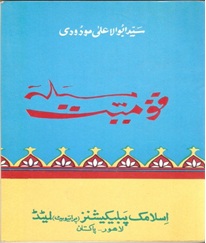
In this book, the author describes that nationalism is dangerous when it becomes a source of discrimination, inequities and separation.
Though, it is natural that human beings would live in society and have commonality of language, culture, vision, worldview and even political and economic systems, but these foundations of nationhood shall not become a source of exclusion, discrimination and superiority complex.
Author gives an example that human beings take milk from cows of every colour. However, racism and discrimination is still present in society.
It can distort peace, human rights and even retard advancement of science. If people are driven strongly by nationalism, then they will see history, political affairs, economic affairs and even science and knowledge from their nationalistic lens. It can be limiting and exclusionary.
Islam has a natural stance on individual and social identities. The diversity is mandated by the Creator, but all the diversity in human beings and other things in nature owes its origin to the Single Creator. All have common origin of creating agency, which is the Ultimate Creator.
All human beings are alike in their identity as humans. Prophet Muhammad (pbuh) in His Last Hajj sermon said:
“O’ ye people! Allah says: ‘We created you from one male and one female and made you into tribes and nations, so that you can know one another. Verily in the sight of Allah, the most honoured among you is the one who is most God-fearing. There is no superiority for an Arab over a non-Arab and for a non-Arab over an Arab or for the white over the black or for the black over the white except in God-consciousness.’”
Describing the importance of private property rights, Prophet Muhammad (pbuh) said:
“O’ people! Verily your blood, your property and your honour are as sacred and inviolable as the sacred inviolability of this day of yours, this month of yours and this very town (of yours). Verily, you will soon meet your Lord and you will be held answerable for your actions.”
Describing the concept of Muslim brotherhood, Prophet Muhammad (pbuh) taught:
“O’ People! Every Muslim is the brother of every other Muslim, and all the Muslims form one brotherhood. And your subordinates; see that you feed them with such food as you eat yourselves, and clothe them with the clothes that you yourselves wear.”
In Islam, there is no racial, linguistic, regional or gender discrimination. Qur’an mentions the attributes of good Muslims in both masculine and feminine adjectives. The only thing which differentiates is God consciousness which requires humility and moral conduct in social sphere of life rather than feeling superiority on any pretext.
Instead of autocracy and exploitation, Islamic principles engender strong accountability (Hisbah), limit the government’s power of levying exorbitant taxes and ensure socio-economic justice and civil equality. Islam directs Muslims to uphold justice and instructs that even enmity of a nation must not make them leave the path of justice (Al-Maida: 8). Injustice is one of the main hurdles in bringing about peace in this world. Injustice in politics, in economics and in every sphere of life must be avoided as per Islam.
On the other hand, Secularism as a philosophy or comprehensive doctrine is not entirely democratic if it does not allow religion to prevail in the public sphere of life even democratically. Islam permits individual freedom in the choice and practice of one’s religion or comprehensive doctrine. Some Muslim countries may not present the best examples of this commitment and they should correct themselves based on Islamic injunctions.
Secularism claims to be ‘neutral’ about religion, but in effect, it could turn out to be ‘insensitive’ to religion in several practical instances. Can we say there is a discrepancy between philosophy and practice? However, in the case of ideologies like Secularism, nothing is divine. Both its philosophy and practice is a result of human conception and attitudes. In its worst examples, the ‘public’ sphere of life can result in laws and policies which ban Hijab, beard, modest dress and in the case of a recent event, the ban of particular names for babies in some places in East Asia. ‘Private’ sphere of life then reduces to home alone. That is in private sphere since ancient times anyways.
There are also several misconceptions about the rights of non- Muslims in an Islamic socio-political framework. Non-Muslims can worship at their worship places. Furthermore, the government is responsible to safeguard their worship places. No non-Muslim can ever be forcibly converted to Islam. In Islam, Muslims believe in all Prophets sent by Allah including Ibrahim (pbuh), Moses (pbuh) and Jesus (pbuh).
In Muslim Spain, Christians and Jews lived together. With the advent of Islam, it became possible that people could choose to hold on to their beliefs which could be different from the state religion. Thus, Islam is against all forms of religious and socio-political persecution and discrimination.
In the early Islamic period, non-Muslims in routine socio-economic milieu owned property and engaged in businesses. Non-Muslims who could not earn their livelihood received assistance from Bait-ul-Maal (national funds managed by the state) as well as enjoyed access to services of Islamic public endowments. In routine engagement and relation with people of different ideologies, Qur’an describes the manner of presenting its message as follows: “Call men to the path of your Lord with wisdom and kindly exhortation and debate with them in the most befitting manner…” (Al-Nahl: 125). Author has done a marvellous job of highlighting how nationalism can be dangerous in politics, economy and trade at macro level and disturbing diversity, inclusivity and justice at the micro level. Common points of engagement shall be universal values and principles which are well encapsulated in Islamic worldview and teachings.
 Islamic Economics Project