

| Title: License to be be Bad Author: Jonathen Aldred Publisher: Allen Lane |
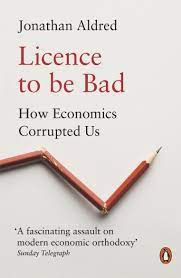
In this book, Cambridge academic Jonathan Aldred writes that many economists proudly see themselves as unsentimental, straight talking and brutally honest. For decades, the default starting point of mainstream economists has been to assume that selfishness is the natural, dominant determinant of human behaviour. This is in contrast to Adam Smith who wrote ‘The Theory of Moral Sentiments’ before his magnum opus ‘The Wealth of Nations’.
Aldred focuses on microeconomic theories of behaviour popularised by researchers often connected to the Chicago school and the Rand Corporation. These include the macroeconomist Milton Friedman, who argued corporations only had a duty to maximise profits; Gary Becker, who applied the tools of rational optimisation to areas such as the family; and the game theory pioneer John Nash.
Author asserts that a set of controversial, free-market economic views have come to dominate our way of thinking. At the heart of the Chicago School is the idea that governments and regulators should stay out of the economy as much as possible. The free market should decide where money is made and spent, not public officials.
The school provided the theoretical backbone to Reaganomics and Thatcherism, which introduced radical free-market ideology to the US and UK respectively in the 1980s. Along with some other ideologically similar ideas, it’s been dominant ever since, and many see it as the only correct way of thinking about economics. But are they right?
2007 changed all that. In 2007, the global economy came crashing down. Markets and banks nosedived, and countless people lost their jobs and livelihoods. But whose fault was it? A lot of people have blamed the financial regulators – pointing toward governments and lawmakers, rather than the banks themselves.
Author thinks that it’s like blaming the police for a burglary, which doesn’t really make sense. So, why should it make sense when it comes to finance? Author highlights that this is exactly the kind of thinking the Chicago school encourages.
Author writes that economic theory is also behind how we think about climate change. It’s common these days to adopt free-rider thinking – the belief that because our own contribution to change is so minimal, it’s not worth doing at all. This has encouraged irresponsibility, insensitivity and procrastination which is destroying our planet.
Now, among academics, there is realization for focusing on externalities, moral hazard and inductive data-based researches. Agent based modeling, experimental research and randomized control trials are replacing the self-interest centric deductive mathematical modelling as sole referee of how things work.
Aldred explains why the use of incentives often backfires (for example, paying blood donors leads the quantity and quality of blood donations to fall). He challenges the very ethical basis of using financial incentives, arguing that if they are predictably effective, then they undermine people’s freedom and exert control in an unethical way. He emphasizes on the point that ideas have consequences and economists should be careful about how their ideas are translated and implemented.
Author explains that certain traits are kept alive by practicisng. Altruistic acts have empotional and social benefits. Idea that since resources are scarce, one should not be altruistic unless there is no other way creates unnecessary tension between values and economics. In many less developed countries including Indonesia and Pakistan, it was philanthropic spending which kept the resources flow from the haves to the have-nots in Covid-19 market lockdown even when the governments did not have enough fiscal space.
Nonetheless, the author delves more deeply in normative analysis than providing empirical proofs. Economists like evidence, and while Aldred is long on entertaining narrative, he is short on convincing proof.
There is a shift to focus on issues of inequality, externalities and moral hazard. In development economics, there is increased focus on differential diagnosis. After new growth theory, there is more focus on inductive, experimental and field studies than developing mathematical models which could be universally applicable. Works by Duflo and Banerjee and their recognition at the Nobel Laureate level is gradually shifting the orientation.
Hence, economists which are part of this shift and at the frontier of research may feel that the criticism is even though largely correct, but it is outdated at this point. Nonetheless, those shift at frontiers of research have still not impacted the Economics 101 classroom curriculum which is still too heavily reliant on free-markets and the other diverse schools of thoughts in economics are not given due attention.
 Islamic Economics Project