

| Title: | Six Thinking Hats |
| Author: | Edward de Bono |
| Publisher: | Penguin Publishers, 2010 |
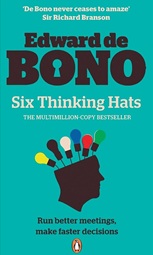
Six Thinking Hats by Edward de Bono is a powerful technique that helps people to explore different perspectives towards a complex situation or challenge. It simplifies thinking by creating focus on one thing at a time, and allows us to engineer switch in thinking without offending others. It has been proven to significantly reduce meeting times, improve the quality and speed of brain-storming and decision-making, and improve thinking productivity.
A big problem of traditional thinking is that people tend to think inflexibly, looking at things from one angle. What they see can be totally correct – however, what you see from a different angle will not be wrong either. Thinking like this, we desperately lack objectivity. According to de Bono, we get tangled in a web of information, emotions, creativity, logic, and many other things, which makes us disperse our energy.
The main challenge of thinking is trying to juggle too many things all at once. The Six Hats allow us to systematically focus on different aspects of a situation or decision, so we become more focused yet see a more complete picture.
The author writes: “The main difficulty of thinking is confusion, where we try to do too much at once. Emotions, information, logic, hope, and creativity all crowd in on us. It’s like juggling too many balls.”
The author further elaborates: “Real life, however, is very different from school sums. There is usually more than one answer. Some answers are much better than others: they cost less, are more reliable, or are more easy to implement. There is no reason at all for supposing that the first answer has to be the best one.”
He reminds us that real-life situations are multi-faceted; unlike the structured problems we solve in school where there is a single correct answer to each. Since multiple solutions can exist in real-world scenarios, we must evaluate answers based on cost, reliability, and ease of implementation.
The author reasons that creativity involves provocation, exploration, and risk-taking. Creativity involves “thought experiments.” You cannot tell in advance how the experiment is going to turn out. But you want to be able to experiment.
Each of the Six Thinking Hats represents a different style of thinking.

Blue hat is the hat of an overall organizer and monitor. The blue hat is the control hat. The blue hat sets the agenda, focus and sequence, ensures that the guidelines are observed and asks for summaries, conclusions, decisions and plans action. This hat is all about control, planning, and organizing.
This hat should be worn by the leader of the meeting from the beginning to help define issues and maintain focus. The blue hat can be used individually for effective daily planning, scheduling, and other activities that depend on organized thinking. This hat is useful in analysing the results that come from wearing other hats and helps tie things together.
Green hat is the creative hat that generates ideas. The green hat is for creative thinking and generating new ideas, alternatives, possibilities and new concepts. Green represents creativity. This is the brainstorming hat, where lots of thoughts and ideas are coming fast.
The focus here is about “what ifs” and generating as many ideas as possible without judgment or criticism. This flow of ideas will create a lot of potentially irrelevant material, but it will also uncover some revelations that just could not be seen when wearing a different hat. Even the seemingly “bad” ideas may become useful when viewed with a different hat.
Red hat is the hat for the heart, gut feelings and emotions. It captures intuition and feelings. The red hat is about feelings, intuitions and instincts. The red hat invites feelings without justification.
Yellow hat is the optimist hat. It concentrates on benefits and values. The yellow hat is for a positive view of things. It looks for the benefits and values. The yellow hat is the “positive thinking” hat. This mode of thinking focuses on constructive, progressive points of view.
Balanced thinking requires the ability to see best case scenarios and rewarding outcomes just as much as it depends on critical analysis. Wearing the yellow hat means keeping negatives in check and a willingness to take a leap of faith that things will come together and work out in the end.
Black hat is the cautious hat. It focuses on caution. The black hat identifies risk. It is used for critical judgment and must give the logical reasons for concerns. It is one of the most powerful hats. Black is the colour of critical thinking. Playing the devil’s advocate is an important part of making decisions and requires objectivity.
Wearing this hat enables people to view ideas and decisions with a focus on flaws and errors. Evaluating the decision making process as it is unfolding provides the chance to find inconsistencies, vague points, and anything else that prevents the final solution from being effective.
White hat is the factual and information hat. The white hat is all about brute facts and information. What information you have, what information you need and where to get it. When it’s time to gather the facts objectively, it’s time to put on the white hat.
The thought processes here should be about what information is available and what additional information is needed. This provides an opportunity to make sure everyone involved is aware of the facts and how they impact the issue at hand. Individually, the white hat represents a mind-set for research, intense reading, and other tasks that create better understanding.
The author emphasizes the importance of parallel thinking. Thinking in these six perspectives helps in concentration, convergence, holistic view, time-saving and building consensus quickly. The author explains that in group discussions, it is essential that everyone uses the same hat (mode of thinking) at the same time. This is to avoid personal preferences and conflicts between modes of thinking.
There are many benefits to using this method, including
- More power: Fully utilizing the thinking capacity, experience and knowledge of all the group members.
- Saves time: There is no longer a need to respond out of politeness, or to argue every point of view. Meetings can take less time.
- Removes ego: There is no ego to be exerted from attacking and putting down others.
- Simple: By focusing on one thing at a time, it is easier to focus on complex tasks/ challenges and get a full picture at the end.
- Enhanced creativity: By pushing you to step away from your default approach to making decisions, it can lead to more creative thinking. Also, the coming together of various perspectives can often lead to more innovative ideas.
- Greater inclusivity: Since the Six Hats method only makes sense when everybody in the team focuses on a problem from one angle at a time, it can create a shared understanding and make teams more inclusive.
- Better thinking: This approach improves the team’s ability to think critically. By ensuring that every angle of a problem is covered, it raises confidence in the final decision. It helps teams use all available information about a situation and practice lateral thinking.
- Improved interpersonal skills: De Bono’s approach makes team members ask questions and practice active listening. It teaches them to be persuasive and helps them resolve differences in thinking and opinions.
The author explains that Hats are about direction (“what can happen”), not descriptions (“what is” or “what has happened”). Hats are not meant to label or categorize people; The main idea is that all of us can and should think in every direction.
From an Islamic perspective, Qur’an also advises that we guard ourselves against hastiness, short-sightedness, becoming overoptimistic and spending lavishly or becoming stingy and avoiding benefit to self and others. Prophet Muhammad (pbuh) also advised caution, thinking, taking a holistic view, consulting and He Himself practiced these attributes.
 Islamic Economics Project