Tag: Capitalism

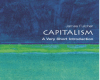
Capitalism: A Very Brief Introduction

Capitalism is defined by the Cambridge dictionary as, ‘An economic and political system in which property, business, and industry are controlled by private owners rather than by the state, with the purpose of making a profit.’ Following this definition, not every country can be considered ‘capitalist’.

Rate this:

Moral Reflections on Economics, Vol 5, Issue 12

December 2025 issue (Vol 5, Issue 12) of Moral Reflections on Economics features: “The Dual Structure of Islamic Economics: Economics of Religion and Religious Economics” by Assoc. Prof. Dr. Mohd Nahar Mohd Arshad, Department of Economics, KENMS, IIUM;
“Stabilizing Purchasing Power of Common Medium of Exchange”  by Hifz Ur Rab; Highlights of Islamic Finance Development Report by Hammad; Book review of “Capitalism: A Very Brief Introduction” by James Fulcher reviewed by Aisha Wani; Research paper in focus on “Utility Maximization, Morality, and Religion” by Dr. Jonathan E. Leightner and regular sections of reflections, market news, economic and financial indicators and call for papers.

Download at: https://islamiceconomicsproject.com/periodicals/

Rate this:

Zakah Driven Islamic Economy and Interest Driven Capitalism

Entrepreneurs may have less or more capital than they plan to invest. Owners of surplus capital may withhold it or may make it available to investors. This may be based on profit sharing ratio or interest. In the Islamic system, charge of Zakah assisted by expected share in profit motivates the owners of capital to get it invested while in a capitalist system, interest motivates the capitalist creditors to lend capital for earning interest.

Rate this:

Labour in Comparative Economic Systems

In Marxian economics, it is argued that labor creates surplus value in the production process that capitalists extract in the exchange process. Marx said that the capitalist purchases the use value of labor (service) and pays labor something equivalent to the exchange value of labor time. It is barely enough to keep the labor survive. However, when the capitalist sells products created by “labor power,” these products command more exchange value and this excess is known as surplus value. The surplus accumulates and this is exploitation of labor by the capitalists.

Rate this:

Inflationary Burden of Taxes

Despite huge burden of taxes in this budget, 75% of all tax revenues will just go in paying interest on and instalments of previous debt. Last year, government spent around Rs 400 billion in PSDP. Spending every year in PSDP falls short of announcement. This Rs 400 billion is less than even 5% of what we will pay in debt servicing and less than 20% of what we will spend in defense.

Rate this:

Implication of Greed in Resource Conservation

Money supply can be increased out of thin air, but the non-renewable resources once exhausted cannot be brought back. Remarkably, the importance of ecology is not learnt even after repeated unsuccessful expeditions in space to search life supporting environment. An illuminating, enlightening and informative book cannot be valued just by measuring the cost of pages, printing and binding.

Rate this: