

Authors argue that theoretically, Zakat can promote the higher objectives of a country’s economy. The imposition of Zakat on the assets and business of Muzakki provided the conditions of the haul and nisab have been met encourages the productivity of Muzakki. It urges them to be productive and prudent in their investments. It triggers an increase in labour supply and investments. Zakat transfer leads to higher consumption and spending which is good for the businesses and economy.
Environmental Teachings in Islam
Climate change and environmental degradation is a slow and cumulative process. To protect environment, the efforts also need to be cumulative and consistent. A self-centric secular worldview encourages the self-centric use of private property resources. However, even small things done collectively and consistently can have a larger effect. The two-worldly view of life in Islam encourages socially responsible behaviour as one of the prime determinants of salvage in the life hereafter. Prophet Muhammad (PBUH) said: “If the Resurrection were established upon one of you while he has in his hand a sapling, then let him plant it.” (Musnad Ahmad, Hadith No. 12491).
Sustaining Value-Based Intermediation Initiative via Cash Waqf Models

This study provides insights to the stakeholders of a Cash Waqf infrastructure to continue strengthening their role by understanding the embedded physical and spiritual values and benefits of their acts. It is pertinent for regulators to further encourage VBI among Islamic financial institutions, towards attaining the pure philosophical foundations of Islamic banking and finance; i.e., the principles of socio-economic justice and brotherhood.
Mapping Issues in Labor Economics: An Islamic Perspective for Research and Policy Development

We are living in a capitalist society where wealth is circulated mostly among the rich. This creates systematic inequality and this issue continues to further exacerbate the hardships faced by the workers. There are various studies on Islamic banking and finance, but the labour side of Islamic economics is not much focused upon and the number of research studies are limited. The purpose of this study as explained by the author is to explore the progress made in labor economics from an Islamic perspective, especially in advancing policies that can improve the well-being of workers.
Moral Reflections on Economics, Vol 4, Issue 2

February issue of Moral Reflections on Economics is online. It features article on Liquidity Risks in Islamic Banks, Roundup of Al Baraka Forum 2024, IEP Public Poll results on Cost of War in Gaza, book review of Economics of Prophet Muhammad (pbuh) by Syed Fazlur Rehman, research paper in focus on Cash Waqf in Malaysia by Zaki Ahmad, Mushtaq Ahmed & Mahvish Nawaz Mokal and regular sections of reflections, news, economic and financial indicators and call for papers.
Halal Tourism Beyond 2020

Muslim population comprises one-fourth of the global population. In 2060,31.1% of the 3 billion people will be Muslims. In complying with Islamic teachings, Muslims want to have Halal options of banking, investments, food and apparel. Nonetheless, in many other product segments, there is no distinction between Halal and conventional products and services. In Fiqh-ul-Muamlaat, except Haram, other things are considered Mubah. Hence, instead of a positive Halal list, a negative non-Halal list is enough.
Moral Reflections on Economics, Vol 4, Issue 1, 2024

January 2024 issue of Moral Reflections on #Economics is online. It features article on UN #SDGs and #Gaza Crisis, Highlights of Multidimensional #Poverty Index Report 2023, IEP Public Poll results on Economic Boycott, book review of #Islam and Economic Security by Yousuf Qaradawi, research paper in focus on #Halal tourism by Dr. Punit and regular sections of reflections, #news, economic and financial indicators and call for papers. Download for free.
Experts Urge Turning to Islamic Economics for Meeting SDGs
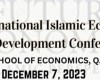
Experts urge adopting Islamic Economics to meet Sustainable Development Goals at Ist Islamic Economics and Development Conference at Quaid e Azam University Islamabad on December 7, 2023.
A Reflection of Divine-based Islamic Economics

This paper provides reflection on Islamic economics and rightly concludes that a lot of work needs to be done in providing distinct story of why financial and economic crises happen and what Islamic economics can offer through its principles, values, instruments and markets.
Do Islamic Microfinance Institutions Affect the Socio-economic Development of the Beneficiaries

This paper aims to investigate the effect of Islamic microfinance on poor households through the case of the IKSAR Qard al-Hasan Program in Turkey. It examined the changes in the socio-economic status of beneficiaries before and after the program. The study indicated that Islamic microfinance and qard al-hasan, which were combined in the IKSAR Qard al-Hasan Program, have direct and indirect positive effects on the borrowers.
 Islamic Economics Project