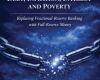
This is reply to the second rejoinder written by authors of the book “Breaking the Trap of Debt, Inflation, Interest and Poverty” while responding to the book review.


This is reply to the second rejoinder written by authors of the book “Breaking the Trap of Debt, Inflation, Interest and Poverty” while responding to the book review.
It is encouraging to see the commitment of the authors to engage with criticism of their proposal. Such efforts to engage with critical issues of the economy and society are highly respectable and deserve appreciation. Some further clarifications are humbly provided in response to the rejoinder by the authors.

February 2026 issue (Vol 6, Issue 2) of Moral Reflections on Economics features
• “Pricing Benchmark, Money Market Instruments and Monetary Policy” by Salman Ahmed Shaikh.
• “Money and Inflation” by Hifz ur Rab.
• Highlights of Oxfam Report on “Resisting the Rule of the Rich” by Muhammad Hammad.
• Book review of “Iqtisaduna” by Baqir Us Sadr.
• Research paper in focus on “Breaking Bad: How Health Shocks Prompt Crime” by Steffen Andersen, Elin Colmsjö, Gianpaolo Parise, Kim Peijnenburg.
• Regular sections of reflections, market news, economic and financial indicators and call for papers.

June 2025 issue (Vol 5, Issue 6) of Moral Reflections on Economics features article “Beyond Integrative Approaches: Methodological Tensions in Islamic Economics” by Aaliah Rafee, highlights of the IFSB Report 2025 by Muhammad Hammad, article on “What is Money” by Muhamed Ahmed, book review of “Economic Thinking of Arab Muslim Writers During the Nineteenth Century” by Prof. Abdul Azim Islahi, research paper in focus on Homo Islamicus and Homo Economicus by Dr. Setiawan and Dr. Sultan, reflections on Khutba-e-Hajjat-ul-Wida and regular sections of market news, economic and financial indicators and call for papers.

January 2025 (Vol 5, Issue 1) issue of Moral Reflections on Economics is online. It features article on Theories of Economic Development and Islamic Economics, Highlights of Global Hunger Report 2024 by Hammad, IEP Public Poll results on Challenges to Banking Sector in 2025, book review of Reconstruction of Religious Thought in Islam by Allama Iqbal, research paper in focus on The Value of Societal Values in Finance by Carolin Schellhorn, Reflections on Quran and Ethics by Abrar Ahmed and regular sections of market news, economic and financial indicators and call for papers.

Use of mathematics in economic theorizing has restricted economic analysis of consumer behavior within a confined boundary of certain axioms. Often, these axioms are found to be empirically false.

January 2024 issue of Moral Reflections on #Economics is online. It features article on UN #SDGs and #Gaza Crisis, Highlights of Multidimensional #Poverty Index Report 2023, IEP Public Poll results on Economic Boycott, book review of #Islam and Economic Security by Yousuf Qaradawi, research paper in focus on #Halal tourism by Dr. Punit and regular sections of reflections, #news, economic and financial indicators and call for papers. Download for free.

Islamic worldview does not oppose the use of various tools for obtaining useful knowledge and then using that knowledge for material ends both at an individual and societal level. When one reads Quran, Allah is again and again inviting people to ponder over their creation, environment, ecology, design, variety and balance in the organization of matter in the universe in order to decipher the meaning of life amidst all these manifestations. Question of ‘why we exist’ is the focus of Islam. Question of ‘what exists and how’ is the focus of science. Thus, Islam and science are parallel rather than perpendicular to each other.
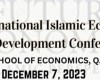
Experts urge adopting Islamic Economics to meet Sustainable Development Goals at Ist Islamic Economics and Development Conference at Quaid e Azam University Islamabad on December 7, 2023.

Boycotts are more effective when boycotting consumers make up a large market segment, have substitutes and when consumers can boycott for long.

