

Prof. Dr. Abdul Azim Islahi
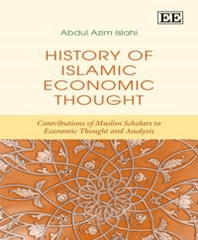
This meticulously written book illustrates the contributions made by Muslim scholars to economic thought throughout history. It is a topic that has received relatively little attention in mainstream economics. The author aptly answers the Great Gap hypothesis by Joseph Schumpeter.
Prof. Abdul Azim Islahi discusses various ways in which Muslim ideas reached the European West, influencing scholars and helping to form the foundations of modern economic ideas and theories.
Prof. Islahi argues that Muslim scholars made substantial contributions to economic thought, influencing both the development of Islamic economics and, indirectly, the foundations of modern Western economic theory. He challenges the notion that modern economics is solely a product of Western thought, highlighting the intellectual debt owed to earlier Muslim thinkers.
The book traces the evolution of Islamic economic thought through distinct phases, from its early formation based on the Quran and Sunnah, through periods of significant intellectual flourishing and interaction with other cultures, to its modern revival.
Prof. Islahi examines the contributions of Muslim scholars to various economic concepts and theories.
In value theory, Muslim scholars provided Islamic perspectives on value, emphasizing ethical considerations and the concept of ‘just price’.
In market and pricing, Muslim scholars talked about market mechanism, competition, and price determination, highlighting the importance of fairness and transparency.
On production and distribution, Muslim scholars presented Islamic approaches to organizing production process with labour, capital and entrepreneurship with no fixed compensation to capital. They also highlighted the principles of equitable distribution of wealth.
Muslim scholars also explained Gresham law ‘bad money driving out good money’ much before Gresham. They discussed the problems and effects of counterfeit money. Imam Ghazali and others discussed the functions of money and how interest is not a just price of money.
Muslim scholars also highlighted the role of the state in regulation and monitoring. They covered the key principles which are now considered the cornerstone of long run macroeconomics, growth theory and institutional economics.
Ibn-e-Khuldun provided a theory of civilizational development and decline through the concept of social cohesion. Ibn Khuldun is known for his pioneering work on social and economic dynamics, including his theory of cyclical economic development. Ibn-e-Khuldun also explained supply side economics and cautioned against raising the marginal rates of taxation excessively as it may kill the incentives.
Muslim economists explained division of labour, specialization of tasks and labour theory of value much before Adam Smith and David Ricardo. It is not just in theoretical knowledge that Muslim economists contributed, Muslim civilization also established institutions which became precursor to the modern day commerce and economy.
The use of cheques, partnership modes, agency based depository services and Waqf-based enterprise were some of the notable institutions. Mawardi, Farabi and Shah Waliullah discussed the importance of transparency, peace, order and good governance. They emphasized on the responsibility of the state for ensuring social justice, providing public goods, and promoting economic development.
Prof. Islahi explores the ways in which Islamic economic ideas, transmitted through various channels, influenced European scholars and contributed to the development of modern economic thought. Translation works enriched the knowledge of scholastics. The ideas are unique to Greek as Muslims focused on the inductive approach and on establishing modern institutions of commerce and trade which were not there in Greek.
While Max Weber and Joseph Schumpeter are incorrect to undermine the role of Muslim scholarship and civilization, the other authors such as Briffault, Durant, Sarton, Koehler and others acknowledge the role of Muslim scholarship and civilization and this is also documented by Prof. Abdul Azim Islahi.
The book is a valuable resource for anyone interested in the history of economic thought, Islamic economics, or  the intellectual history of the Muslim world. It provides a comprehensive and insightful account of the rich tradition of Islamic economic thought and its enduring relevance for contemporary economic discourse.
Categories: Articles on Islamic Economics
 Islamic Economics Project