

| Authors: Qanit Khalilullah and Sohaib Umar Reviewer: Salman Ahmed Shaikh |
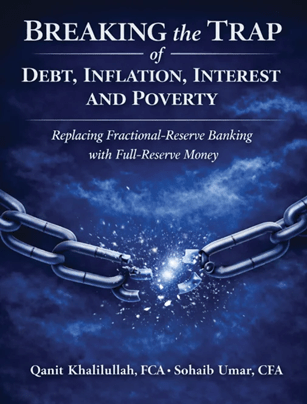
The book by Qanit Khalilullah and Sohaib Umar offers a critique of the modern fractional-reserve banking system, arguing that it is the primary engine behind chronic economic instability, inflation, and wealth inequality. The authors propose a radical macroeconomic transition to a full-reserve banking model. This proposal is specifically tailored as a structural panacea for Pakistan’s crippling debt crisis, while simultaneously being framed as a genuine path to establishing a Shari’ah-compliant Islamic financial system.
The Central Thesis of the Book
The central thesis of the book is that commercial banks, rather than the state, wield the power to create the vast majority of modern money simply by issuing loans. Because money is created as a digital accounting entry tied to a debt obligation, the money supply cannot grow without a corresponding increase in systemic indebtedness. The authors critically assert that this debt-based money creation incentivizes continuous monetary expansion, which outpaces real economic output and results in persistent inflation.
This architecture inevitably leads to the financialization of the economy, where capital flows into speculative assets and real estate rather than productive enterprises, thereby concentrating wealth among asset owners and penalizing wage earners through inflationary erosion. Furthermore, the inherent mismatch between short-term demand deposits and long-term loans makes the banking system structurally fragile and prone to bank runs, necessitating constant state bailouts and leading to a loss of true monetary sovereignty.
The Proposed Plan: Full-Reserve Banking
To resolve these systemic flaws, the authors advocate for a full-reserve (or 100% reserve) banking model. Under this paradigm, the privilege of money creation is stripped from private commercial banks and returned exclusively to the state via the central bank. The central bank would issue debt-free sovereign money strictly aligned with real GDP growth to ensure price stability and avoid the inflationary pressures of the current system.
The operational mechanism of this proposal rests on the strict functional separation of banking activities into a deposit section and an investment section. Transaction deposits, used for daily payments, would be held merely for safekeeping, 100% backed by central bank reserves, and never lent out.
Depositors seeking returns would actively transfer funds into risk-bearing, time-locked investment pools used by banks to finance real economic activities. To prevent political abuse of sovereign money creation, the authors propose an independent Money Creation Committee bound by strict, auditable, rule-based frameworks.
For Pakistan, the authors outline a rapid and seamless transition mechanism. The State Bank of Pakistan (SBP) would raise the reserve requirement on demand deposits from 5% to 100%. To meet this massive new requirement, commercial banks would transfer their holdings of interest-bearing government securities to the SBP. In exchange, the SBP would issue sovereign, non-interest-bearing reserves to the banks to back the customer deposits. The SBP would then cancel these government securities, effectively wiping out the vast majority of the government’s domestic debt overnight.
The book claims that by extinguishing the domestic debt held by banks, Pakistan would save approximately Rs. 5.8 trillion annually in interest payments, freeing up nearly half of the federal budget for development and social welfare without triggering inflation.
Furthermore, the authors bridge macroeconomic theory with Islamic economics, arguing that the current fractional-reserve system is inherently tied to Riba (interest) because it institutionalizes risk-free returns on artificially created money. Full-reserve banking, they argue, forces a transition to true risk-sharing models like Mudarabah and Musharakah, perfectly aligning with the Objectives of Shari’ah (Maqasid Al-Shari’ah).
Objective Review of the Proposal
Centralized Monetary Planning and Political Realities
It is a welcome attempt to write on pressing issues and deliberate on solutions, even if they are non-traditional and radical. However, before taking any steps, it is also important to have clarity, refinement, and modification to ensure suitability, resilience, robustness, and reality checks.
The proposal is not asking or providing a replacement of fiat money. It is focusing on who can create fiat money and how. The proposal ties monetary expansion to economic growth and delinks it from a debt transaction. Since it is an economic proposal about who can create fiat money and how, it is analysed from that perspective.
A primary concern is that the book exhibits extreme over optimism regarding the governance and political realities of Pakistan. The authors propose an independent ‘Money Creation Committee’ that will mechanically tie money creation to real GDP growth, perfectly insulating the money supply from political pressure.
Relying on a central committee to have perfect hindsight and foresight about the complex preferences and expectations of consumers, firms, and investors is a humongous task. Consequently, the risk of coordination failure is quite high. More importantly, political influence would increase further in a fragile democracy where token benefits near elections matter a lot. Under a sovereign money or full-reserve system, the government captures 100% of the seigniorage. This creates a severe moral hazard, giving politicians an overwhelming temptation to fund pet projects and win elections by endlessly printing money, which directly increases the risk of hyperinflation.
Governments will ultimately have more control with data dissemination, the committee, and legislation firmly in their hands to manoeuvre the economy exactly as they want. Without the banking sector to naturally absorb government debt, a politically fragile government facing a budget shortfall will inevitably pressure the Money Creation Committee to create emergency sovereign money.
Transitioning the monopoly of money creation exclusively to the state in a country with a history of weak fiscal discipline is a recipe for the exact type of unchecked fiat printing that has historically led to hyperinflation in countries like Zimbabwe or Venezuela. Theoretically, money expansion linked with a debt obligation can foster discipline as well, rather than letting the government print fiat sovereign money out of thin air through arbitrary and centralized planning, not keeping in view the preferences and expectations of consumers, firms, and investors.
To justify the avoidance of interest rate adjustments to regulate the money supply, the authors are willing to allow an even more blanket way of intervention to the government by having 100% seigniorage revenue and the ability to create fiat money without debt obligations, and hence without having to pay interest.
If decentralized commercial banks lose the power to create and allocate credit based on market risk, the responsibility for injecting new money into the economy falls squarely on the central bank or the federal government. This fundamentally risks turning credit allocation into a political tool rather than an economic one, potentially leading to inefficient central planning, lobbying, and the artificial propping up of failing industries. Ultimately, the government may print money to fund popular programs, send out stimulus checks, or boost the economy right before an election.
Data Limitations and GDP-Linked Money Creation
Mechanically tying money creation to GDP is challenging due to data limitations. It must be noted that national income accounting in Pakistan is also managed by the Pakistan Bureau of Statistics, which is entirely under the government’s control. Oftentimes, its reports are doubted in the press, and the quarterly GDP calculation has only started recently. The real GDP figures are often revised based on new data. Furthermore, the calculation uses a lot of approximations and is not yet able to give a clear bifurcation of durable and non-durable consumption. By and large, aggregate consumption at the national level is just an approximation rather than a meticulously measured direct measure.
Even beyond the accuracy of the data, the mechanical application of this rule is dangerous because real GDP growth can be negative. In recessions, the economy requires more liquidity and monetary injections to recover. By only expanding the money supply at the rate of GDP growth, it is feared that the policy may heat up the economy fast while deepening the recessions. The current system allows the money supply to stretch and shrink organically based on the actual, real-time needs of businesses and consumers. Conversely, a full-reserve system heavily managed by a central bank can be excessively rigid. This inelasticity makes it much harder for the economy to dynamically respond to sudden localized shocks, supply chain disruptions, or rapid technological shifts.
Endogenous Money Theory and Banking Mechanics
The authors lean heavily on the narrative that banks create money out of thin air, implying that this process is unconstrained. While banks do create deposits when they lend, they are heavily constrained by capital adequacy requirements (such as the Basel Accords), liquidity coverage ratios, credit risk assessments, and the central bank’s monetary policy and prudential regulations. It is also a misconception that banks can create unbounded debt and are only constrained by reserve requirements. Banks are for-profit businesses; they have to manage credit risk and liquidity risk diligently. If a bank makes too many bad loans, it goes bankrupt. Moreover, the Basel III framework requires banks to hold a certain amount of their own equity capital relative to the risk-weighted assets, or loans, that they create.
A loan transaction is a voluntary contract between banks and households, and between banks and businesses. On one hand, the book is critical of fiat money coming into existence electronically through simple ledger entries. On the other hand, it is also critical of this fiat money getting destroyed through debt repayments as if it is something akin to a real asset that is getting destroyed. This cycle of creation and simultaneous destruction actually challenges the conception that there is a free lunch on which banks will continuously have a feast over. While the money is not destroyed in the full-reserve banking system, it is rival in use and inherently limited in supply to support various projects simultaneously.
Many countries have done away with reserve requirements altogether, and this has not resulted in an exponential increase in debt. It is because giving out a loan from the bank’s perspective requires multiple other decision criteria, such as creditworthiness, collateral, past history, economic conditions, a project’s potential, impact on the bank’s capital adequacy ratio, liquidity coverage ratio, maturity profile, and value-at-risk.
Furthermore, in an economy like Pakistan, where significant money is kept out of the banks and where nominal interest rates are generally higher, it is better to take the money multiplier with frictions in the examples, as it adjusts for the currency-to-deposit ratio and the excess reserves-to-deposit ratio.
With a comparatively lower money multiplier ratio after adjusting for currency drain and the excess reserve-to-deposit ratio, and given that the required reserve ratio in Pakistan is above 25%, why does it have higher inflation than countries that have even abolished reserve requirements? The authors need to explain the countries with low inflation that effectively use fractional-reserve banking, even with lower reserve ratios and a lower currency drain. Furthermore, some of the countries with relatively lower income inequality also have robust fractional-reserve banking systems.
The Threat of Credit Contraction and Entrepreneurial Exclusion
By abruptly ending fractional-reserve banking, the proposal risks triggering a severe economic contraction. The book assumes that funds will be voluntarily moved by depositors into investment accounts, and this will seamlessly fill the credit void. However, forcing all lending to be strictly backed by time-locked savings or equity pools would drastically shrink the available credit pool. It must be kept in mind that banks can only lend if there are creditworthy households and businesses that actually want to borrow.
Households and businesses would repay debt with interest from their earned incomes, not by creating money out of thin air. The authors note that in Pakistan, the majority of bank lending has gone to the government. In a full-reserve system, where banks only earn through profit shares in risky enterprises, will their inherently risk-averse preferences not exclude small entrepreneurs even then?
In a credit-starved environment, the limited loans that do exist would inevitably be reserved for the absolute safest borrowers. Since the authors mention that their proposed banking structure will still be using debt-based modes of financing, such as Murabaha and Ijarah, financial institutions would likely demand hard collateral to approve a financing request. This would make it substantially harder for lower-income individuals and first-time entrepreneurs who have good ideas but lack existing physical assets to pledge. The book does not talk about pricing of debt based financing products like Murabaha. It also does not discuss how to overcome the moral hazard problem in Mudarabah structure.
There is also a dire need to find viable solutions for short-term financing and long-term financing where break-even can take several years. How would funds come for these when the interest rate is brought to zero and funds are exclusively invested on a profit and loss sharing basis in a small open economy? Because credit would be much harder to obtain, the speed at which money changes hands, or velocity, would likely plummet. Businesses would have to hoard larger cash buffers to ensure they can meet payroll, rather than relying on short-term revolving credit facilities from their banks. A persistent drop in the velocity of money may slow down overall economic growth and innovation.
Assumptions Regarding Bank Profitability
To compensate for the loss of interest income from government securities and lending, the authors suggest banks could charge a 1% annual maintenance fee on demand deposits. The authors claim that a 1% annual fee on deposits totalling Rs. 30 trillion would generate Rs. 300 billion in revenue, which is almost half of Pakistan’s banking sector profits, and this would ensure that banks remain commercially viable. In a cash-heavy, informal economy like Pakistan, this assumption is disconnected from consumer behaviour.
The economic numbers cannot simply be treated as historical accounting records that will stay at the exact same level following a massive systemic shock. Many corporate depositors, especially the large ones, may stop operating in the economy altogether with a 1% charge on deposits. This will inevitably shrink the size of the formal banking sector.
If citizens are told that their savings accounts will no longer yield returns, and instead, they will be charged a 1% fee simply for the bank to hold their money in a vault, it will trigger massive financial exclusion. Depositors will inevitably pull their money out of the formal banking system. This capital will flee into physical cash, gold, foreign currencies through dollarization, or unregulated shadow-banking networks, undermining the documented, formal economy and eroding the tax base.
The authors argue that if just 25% of demand deposits shift to investment funds, the total volume of financing available to businesses could increase by more than 50%—from Rs. 13 trillion to Rs. 20 trillion—providing a major boost to productive investment in the economy. As discussed before, it is highly unlikely to expect that to happen given the risk profiles of average depositors. Risk averse investors may place their wealth in real estate, gold and foreign currency. In that case, the limited funds do not get into the real economy through entrepreneurial investments. In summary, the proposed full-reserve cure relies on backward-adjusting accounting claims assuming that the economic variables will remain fixed at the historic values before and after the change.
Capital Flight and Open Economy Dynamics
The book ignores the profound implications for a small open economy. Capital flight seems to be an imminent eventuality of the proposal, but it is not discussed by the authors. Unnecessary constraints and restrictions would reduce foreign direct investment, foreign portfolio investment, and motivate businesses and multinational corporations (MNCs) to exit. For a short period of time, regulatory curbs can delay capital flight and add friction in the way of capital flight. But when depositors, investors, and businesses think that the adopted policy is not for the short term, but rather a fundamental change of monetary regime, then they will take strategic decisions and possibly exit the economy and local markets. Even with government guarantees, collateral backing, and no limits on the foreign repatriation of profits, the economy is having a hard time attracting investments, both locally and from foreign investors.
The proposal is not touching on land reforms or property rights reforms. Hence, it aims to just put a brake on credit expansion by private banks. Consequently, the current wealth divide would remain exactly as it is, while it may concurrently increase capital flight and motivate MNCs to exit.
Access to capital flight opportunities would also be unequally distributed. Those with foreign passports, foreign sources of income, a foreign commercial presence, and enough capital to buy passports and residencies in other countries would be in a highly favourable position as compared to small depositors who have no such avenues.
Appendix 2 in the book mentions that investment financing is purely saving-based in full-reserve banking. What if savings drastically decline through cross-border investments and capital flight, especially when the proposal demands that investors shall lock their investment for at least 6 months and give a one-month notice for withdrawal even after that maturity?
Corporate Finance and the Banking Sector
It is also a misconception that debt only exists because banks forcefully push it upon the market. In reality, corporate businesses often prefer debt over equity. Debt allows an entrepreneur to retain full ownership, control, and the upside of their successful business, whereas equity financing forces them to permanently dilute their ownership and share control with the bank or an investment fund. Assuming that the entire corporate sector will happily transition to profit-and-loss sharing agreements completely ignores the fundamental mechanics of corporate finance and entrepreneurship. Islamic banks in Pakistan could not motivate large profitable corporations to use the genuine modes of Musharakah and Mudarabah.
Furthermore, since the authors are taking the specific context of Pakistan, it is vital to remember that banks pay massive income taxes, collect several indirect taxes on the government’s behalf, and on top of that, they pay a super tax as well. The effective tax rate on large, profitable banks is almost 50%. They operate under tight central bank regulations, the comprehensive Basel III framework, and a burdensome tax environment. The banking sector has undergone consolidation with several multinational banks exiting, and the number of banks has actually declined in the last 20 years in spite of the broader growth in financial inclusion. Hence, presenting banking as merely a free-lunch business is an exaggeration.
Banks incur high fixed costs of branch operations and constantly provide IT and technology infrastructure. They invest heavily in cyber security to repel cyber-attacks continuously. By having to rely strictly on fee-based income and a highly volatile stream of profits from a thin investor base willing to put investment in risky deposits, they may exit the industry facing these significant fixed costs. The industry would then increasingly be monopolized or even have to be forcibly taken over by the government if the private sector finds it commercially unattractive.
Approaches to Sovereign Debt, Remittances, and Islamic Finance
The authors suggest that government securities will be transformed into an equity instrument. But, who will be interested in holding them when many of the state-owned enterprises (SOEs) are in massive losses, and those which are not, do not primarily look at profit as the only goal? Rather, they subsidize utilities and aim for broad access as a priority goal rather than making profits.
The authors argue that Pakistan can use its annual remittances of US$ 38-40 billion from overseas Pakistanis to comfortably repay its foreign debt of around US$ 100 billion in less than three years. The authors seemingly think that this massive flow coming to the country is owned by the Government and that it can be used by the government to pay off its debt. Any sniff of that possible state capture will make the remitters hold their remittances tightly and avoid at least the official channels.
The authors compare the proposal to Islamic principles, but they do not discuss the foundational Islamic teachings about fulfilling commitments in a debt contract. It seems that not only the government, but also private household and corporate debt will be wiped off the books. If the authors want to have it restructured, then the book at least does not provide any viable details of the possible restructuring.
Furthermore, risk and moral hazard cannot simply be assumed away in full-reserve banking. If banks were to operate like venture capital funds, as in Mudarabah, the past case studies of failed Mudarabah companies in Pakistan provide significant reason to take caution.
It is pertinent to look at all the stakeholders in the economy rather than focusing more on the government and giving it a clean, debt-free balance sheet by the stroke of a pen.
In substituting interest rate adjustments with zero interest and sovereign money creation without a debt and interest anchor, the authors gave the example of Prophet Muhammad (pbuh) not fixing the price even when asked. However, the Hadith actually confirms the possibility of using the price mechanism rather than otherwise. In the case of an Islamic economic framework, ideally, we should move away from interest-based banking as well as fiat money in meaningful ways. The authors keep the fiat money in their proposal as well as the risk-shifting debt based modes of Islamic financing and do not provide sufficient covenants to make the equity modes of financing free from moral hazard problem.
Theoretical Robustness of the Proposal
While the fractional-reserve system is frequently criticized by attributing inequality, inflation, and instability to its very existence, other crucial macroeconomic indicators, such as economic growth, employment creation, poverty alleviation, and living standards as measured by the Human Development Index (HDI), should be actively taken into the discussion as well if the argument for full-reserve banking is made purely on economic grounds.
Apparently, high-income, sustainably growing economies with higher HDI scores and low levels of poverty are precisely the countries with a deeper penetration of the fractional-reserve system, which also has constraining factors, such as interest rates as price of loan, reserve requirements, and multiple limits on capital adequacy and liquidity coverage. Just mentioning a few exceptional historical crises without a deeper causal analysis to firmly confirm causality is not enough reason for a massive paradigm shift on economic grounds alone. A working paper by Benes & Kumhof (2012) is cited, but such theoretical DSGE models often overlook the severe constraints present in real-world transitions. The working paper assumes that the central bank can accurately determine the optimal quantity of money without market signals. It relies on the assumption that structural parameters remain invariant to policy changes.
The authors mostly cite historical quotations rather than robust academic references. It is inappropriate to use an appeal to authority by citing quotes, some of which appeared in the press amidst the economy going through a crisis in vastly different time periods.
Rather than citing the emotional reactions of personalities, it is better to document empirical evidence that can academically establish causality. Pointing to a few aggregate figures also does not fulfil the academic requirement. Many of these quotations are strictly in the context of World War 1, the Great Depression of 1930, the Chicago Plan of the 1930s, and so on.
The monetary system post-1971 is a completely different context altogether. If there was so much promise to the full-reserve banking, it is ironic that why no country has yet adopted full-reserve banking. The proposal ignores constraints in credit supply and places optimistic confidence in the political discipline of the centralized planning through a committee.
Editor’s Note: After this review is published, the authors wrote a rejoinder and which was replied subsequently. The rejoinders can replies can be seen below.
First rejoinder by the authors
Second rejoinder by the authors
Categories: Articles on Islamic Economics

