

| Author: | Angus Deaton |
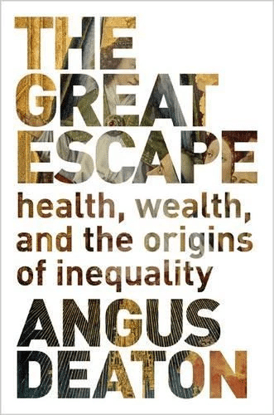
Angus Deaton is the 2015 Nobel Laureate in economics. In his book, The Great Escape, he tells an optimistic recent history of how we have overcome extreme poverty, improved life expectancy, and achieved economic progress. Admittedly, life expectancy has increased substantially since the onset of the 20th century. It is not just the rich who expect a longer lifespan due to technological developments and their mass availability, but poor countries have also witnessed notable improvements.
Extreme poverty has also declined, especially in Asia due to economic growth in East Asia. According to the World Bank, an estimated 808 million people globally are surviving on less than $3.00 a day, representing approximately 9.9 per cent of the world’s population. Optimistically, the Nobel Laureate exclaims that life is better now than at almost any time in history.
In The Great Escape: Health, Wealth, and the Origins of Inequality, Nobel Laureate Angus Deaton provides a sweeping historical analysis of humanity’s remarkable progress in overcoming poverty and deprivation. Prof. Deaton frames this journey as a massive, ongoing escape from the historical traps of high infant mortality, frequent famines, and pervasive destitution.
Driven primarily by the wealth generated during the Industrial Revolution and subsequent breakthroughs in public health, global life expectancy has soared and extreme poverty has plummeted over the past two centuries. This trajectory represents an unprecedented triumph of human ingenuity, demonstrating how economic growth and scientific innovation can fundamentally transform global living standards.
Prof. Deaton emphasizes that this escape is fundamentally uneven, as historical progress inevitably generates profound inequalities between those who break free and those left behind. While post-industrial societies flourish, the bottom billion remain trapped in abject poverty, largely because modern health and economic innovations are distributed through a commercialized global market.
Crucially, Prof. Deaton critiques traditional foreign aid, arguing that large external capital inflows often undermine local governance by removing a state’s incentive to answer to its own taxpayers. Instead of top-down aid, he advocates for structural changes—such as dismantling trade restrictions, permitting temporary migration, and funding research for neglected tropical diseases—to empower developing nations to forge their own institutional paths toward prosperity.
However, discussing these issues without historical and institutional context can lead to a lot of problems in understanding. Prof. Deaton also questions the widespread presumption that rising inequality is always a bad thing. In developing countries, he writes, “inequality is often a consequence of progress.” To the question, “What should we do to alleviate poverty?” Prof. Deaton challenges this question, asking, “Why is it we who must do something? Who put us in charge?” Instead, developed countries should leave developing countries to develop on their own, in their own time, just as the West itself did. He writes, “I have come to believe that most external aid is doing more harm than good.” He writes: “If it is undermining countries’ chance to grow—as I believe it is—there is no argument for continuing it on the grounds that ‘we must do something.’ The something that we should do is stop.”
Nonetheless, Prof. Deaton says that the Great Escape “is far from complete.” Innovations reach only those who can afford to pay for them and that has led to great inequality. In fact, inequality has sharply increased since the 1980s in the West, despite slower growth and despite no evidence of an increase in productivity, at least in the empirical literature. Prof. Deaton correctly notes that the sharp rise in inequality cannot be ignored. If left unchecked, it will undermine economic growth as well as democracy.
One must balance the optimism with some ground realities. The bottom billion, even in the 21st century, suffer from abject poverty and have a low life expectancy. According to the FAO, approximately 800 million people still suffer from undernourishment, and 1 in 12 people goes to bed hungry every day. A quarter of the whole population in Africa suffers from hunger. Also, nearly 50 percent of people living in extreme poverty are 18 years old or younger. This goes to show that a significant portion of our global population does not have a fair start to achieve socio-economic mobility.
On the question of whether the more fortunate, enjoying longer and more affluent lives, should give more money to help them, Prof. Deaton says, ‘No’. The author explains that the main barrier to progress in poor countries is not a lack of resources but bad governments. When these governments receive aid, either directly or indirectly, it brings complacency and dependency, and it undermines their incentives to raise money from their own taxpayers. The author opines that aid mostly goes to countries for political and strategic geopolitical motives. Samoa, for instance, received $802 per capita in 2010, while the highest amount of aid per capita ever received by India was $3.10. When aid comes as ‘tied aid’, the recipient country is forced to use the aid funds to buy goods from the donor country, even when this is a commercially expensive proposition.
However, the author overlooks the fact that poorest countries lack the basic resources to kick-start growth and invest in health and education. Mere scientific solutions to health and education problems solve the supply-side problem, but not the demand-side problem, since these essential services are produced and marketed in the global market economy on a commercial basis. He also ignores the huge transfer of funds from highly indebted poor countries to their rich lenders, mostly in the West. He also treats the issue of ‘tied aid’ quite superficially. If aid comes with ties that impose restrictions on the recipient country, then it undermines its effects. Thus, the problem is not so much with aid per se, but with attaching inappropriate trade ties, starving poor indebted countries by debt servicing, asking for the abrupt commercialization of basic necessities, and imposing free trade reforms.
Many proponents of aid, including Prof. Jeffrey Sachs, argue that people in developing countries are too poor to save and invest in capital that could improve their income prospects. Furthermore, if legitimately elected but weakly funded democracies are not supported in their economic programs, then this could undermine people’s confidence in democracy.
Prof. Deaton considers alternative policies that might be more effective, including removing unhelpful trade restrictions, enabling temporary migration, and providing incentives for drug companies to invest in cures for illnesses such as malaria. Nonetheless, with the weak economic recovery in the West, Brexit, and the contagion effects of the War on Terror, economies may become more restrictive, the cross-border flow of human services may face more friction, and commercial corporations moved by instincts of greed may find no incentive or reason to come to the aid of poor people.
The rapid commercialization of drinking water and other basic necessities is a case in point. More people have access to mobile phones than to basic sanitation facilities in some regions. According to The Hunger Project, 2.4 billion people do not have adequate sanitation, and each day, nearly 1,000 children die due to preventable water- and sanitation-related diarrhoeal diseases. It is partly because sanitation is not as good a business as cellular services. Thus, if public welfare support programs are not supported, it can lead to more gaps in basic service delivery. Thus, on the whole, while we may take courage from the snapshot view, it is not reason enough to turn a blind eye to the significant challenges that we face today.
Categories: Articles on Islamic Economics

