

Dr. Muhammad Umer Chapra was one of the principal scholars and architects of modern Islamic economics. For over six decades, he systematically built the intellectual and operational framework of an economic system that harmonizes material advancement with spiritual and moral values. His life was defined by rigorous academic discipline and highly influential policy work. Global leaders and scholars recognized him as a foundational figure who transformed Islamic economics from a conceptual philosophy into a globally recognized academic and practical discipline.
Dr. Umer Chapra was born on February 1, 1933, in Bombay, British India. Chapra’s family moved to Karachi following the 1947 partition. Despite early financial hardships after his father passed away when Chapra was only six, his mother prioritized his education. This investment paved the way for an extraordinary academic trajectory.
He attended the University of Karachi, topping his class to earn a Bachelor of Commerce (B. Com) in 1954, followed by a Master of Commerce (M. Com) in 1956. In 1950, out of 25,000 students who sat for the high school leaving examinations in Karachi, Chapra topped the list, earning the prestigious Model Student title.
This academic performance caught the attention of the Memnon Welfare Association, which provided him with the scholarship that allowed him to travel to the United States to pursue his Ph.D. at the University of Minnesota. He attended the University of Minnesota, where he earned a Ph.D. in Economics and Sociology in 1961.
Dr. Chapra’s professional career was a unique blend of high-level Western academic training, foundational research in Pakistan, and transformative macroeconomic policy-making in Saudi Arabia.
Before entering central banking, Chapra established his credentials in teaching and institutional research. He worked as a research assistant at the University of Minnesota (1957–1960). Then, he served as an Assistant/Associate Professor of Economics at the University of Wisconsin (Platteville) and the University of Kentucky (Lexington). He briefly returned to Pakistan to serve as a Senior Economist and Associate Editor of the Pakistan Development Review at the Pakistan Institute of Development Economics (PIDE), and as a Reader at the Central Institute of Islamic Research.
In the early 1960s, Saudi Arabian Monetary Agency (SAMA) was in its formative stages and desperately needed elite-tier economists to build a central banking apparatus. Following a lengthy, deep-dive discussion on international monetary mechanics and structural inflation, the Governor offered Chapra the role of Economic Advisor on the spot. This random encounter shifted the trajectory of Chapra’s life, prompting his historic move to Riyadh.
In 1965, driven by a deep desire to contribute directly to the economic development of a Muslim nation, Chapra accepted an advisory role at the Saudi Arabian Monetary Agency (SAMA)—the central bank of Saudi Arabia. What was meant to be a short-term assignment turned into a legendary 35-year tenure. Working alongside Finance Minister Sheikh Mohammed Abalkhail during the reign of King Faisal and successive monarchs, Dr. Chapra played an instrumental role in:
- Designing and modernizing Saudi Arabia’s central banking infrastructure.
- Formulating the Kingdom’s national monetary, fiscal, and economic development policies during critical eras of global oil shocks and rampant inflation.
- In recognition of his immense structural contributions, King Faisal granted him Saudi citizenship—an exceptionally rare honour.
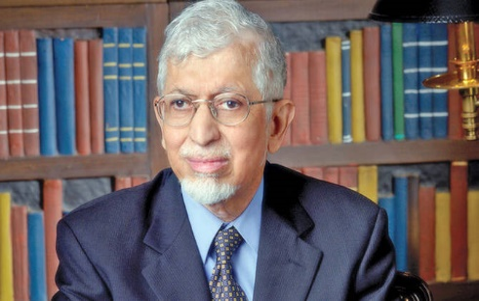
After retiring from SAMA in November 1999, Dr. Chapra moved to Jeddah to join the Islamic Research and Training Institute (IRTI), an affiliate of the Islamic Development Bank (IsDB). Serving as a Senior Research Advisor, he dedicated his final active decades to mentoring young scholars, reviewing global economic policy, and refining the legal and ethical architectures of global Islamic finance.
Dr. Chapra’s primary intellectual legacy is his rejection of the idea that economics is purely value-neutral. He famously argued that conventional systems failed because they separate economics from morality. He held the view that true human well-being (falah) cannot be achieved by market efficiency or material maximization alone; it requires an indivisible matrix that integrates material prosperity with spiritual advancement, equity, and social harmony.
He introduced the idea that societies cannot rely on the price mechanism alone to allocate scarce resources. Instead, an Islamic economy applies a moral filter (internal values that eliminate luxury, waste, and harmful consumption) before the price filter acts in the market.
He pioneered the operationalization of the Maqasid al-Shari’ah (the higher objectives of Islamic law) into development policy, asserting that economic health must be measured by how well a society preserves faith, life, intellect, posterity, and wealth for all citizens.
He provided a rigorous macroeconomic defence against riba (interest), demonstrating that interest-based systems encourage speculation and wealth concentration, whereas risk-sharing, equity-based finance ensures financial stability and social justice.
Dr. Chapra was a prolific author, writing foundational books and monographs alongside several scholarly articles. His works have been translated into dozens of languages, including Arabic, French, Turkish, Urdu, Spanish, and Japanese. Beyond Arabic, Urdu, and Persian, his major works were published in Japanese, Polish, Spanish, French, and Indonesian, making him one of the most widely translated economic writers of the late 20th century.
Beyond policy papers and state budgets, Chapra integrated himself into the highest echelons of international academia to ensure Islamic economic theory was taken seriously by Western secular institutions. His milestones in global scholarly circles included decades-long active memberships in the Royal Economic Society (London) and the American Economic Association. He continued to serve on the editorial and advisory boards of a dozen peer-reviewed international economic journals. He continued to deliver invited masterclasses and keynote lectures at premier universities across the UK, Japan, Spain, South Africa, Egypt, and Turkey, bridging the linguistic and conceptual gaps between classical Islamic jurisprudence (fiqh) and modern mathematical economics.
Some of his notable books include the following.
| Year | Book Title | Significance |
| 1985 | Towards a Just Monetary System | Described by global academics as the most lucid, definitive presentation of Islamic monetary theory ever written. |
| 1992 | Islam and the Economic Challenge | A comprehensive critique of Capitalism, Socialism, and the Welfare State, offering a structural blueprint for an Islamic alternative. |
| 2000 | The Future of Economics: An Islamic Perspective | An academic analysis addressing the philosophical flaws of modern neoclassical economics and calling for a paradigm shift. |
| 2008 | Muslim Civilization: The Causes of Decline and the Need for Reform | A searching historical and multidisciplinary examination of the economic, political, and moral factors behind the decline of Islamic civilization. |
| 2019 | Morality and Justice in Islamic Economics and Finance | A late-career consolidation of his lifelong thesis regarding the indispensable link between corporate ethics and economic justice. |
Dr. Chapra’s academic rigor earned him some of the highest accolades in the Muslim and academic world:
- The IDB Prize in Islamic Economics (1989): Awarded by the Islamic Development Bank for his seminal research contributions.
- The King Faisal International Prize for Islamic Studies (1990): One of the most prestigious awards in the Muslim world, given to him for his ground-breaking work in defining an authentic, workable Islamic monetary framework.
The Presidential Gold Medal (1995): Awarded by the President of Pakistan through the Institute of Overseas Pakistanis for his extraordinary international services to economics and Islam.
The COMCEC Academic Award (2014): Presented by the President of Turkey for his life’s work and outstanding global academic studies.
- ISLAMICA 500 Recognition (2015): Named among the Top 50 Global Leaders in Islamic Economics.
Dr. Umer Chapra successfully bridged the gap between the classical heritage of Islamic jurisprudence and the mathematical, institutional demands of modern central banking. His legacy remains deeply embedded in the operations of Islamic banks, central bank policy sheets, and university curricula worldwide.
He passed away on June 13, 2026, at the age of 93. His funeral prayer (Janazah) was performed inside the Masjid al-Haram in Makkah. He was subsequently laid to rest in Jannat al-Mu’alla. May Allah grant him a place in Jannah. Ameen.
Categories: Articles on Islamic Economics

