

| Title: | Masla-e-Sood (Problem of Interest) |
| Author: | Hazrat Maulana Mufti Shafi Usmani R.A. |
| Publisher: | Maktaba-e-Marif |
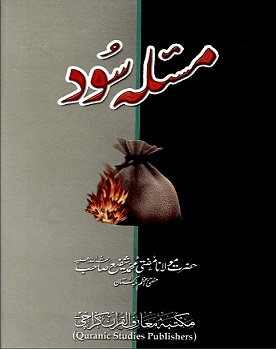
This was an important book in the modern Islamic economics literature from an established and renowned Muslim scholar, Mufti Safi Usmani R.A. The book also has an appendix written by the author’s son Mufti Taqi Usmani, who is himself one of the most established and celebrated scholar in contemporary Islamic studies.
In beginning, the book takes up the task to define Riba unambiguously and clearly. It cites several early jurisprudential works, dictionaries and original sources of Islam to spell out a clear definition of Riba.
Then, the book mentions and explains Qur’anic verses on the prohibition of Riba. After that, the respected author presents gist of extant Hadith literature on Riba which leave no doubt on the prohibition of Riba and that this prohibition is absolute and not concerned with the purpose for which loan is taken or the rate of Riba in the loan contract.
Through careful analysis of Arab history, the respected author explains that most of the loan transactions in Arab at that time were done for commercial endeavors. Tribes used to take loans from other tribes for business purposes. Therefore, it is inconceivable that all loan transactions in Arab at that time were done for personal needs and that Riba prohibition only applies to high interest rate charged on emergency loans for personal needs.
There is no reason left to allow or seek any room for market competitive or lower interest rates in loan transactions. Consent of both parties is a necessary condition for sale, but it is not a sufficient in itself for an act or contract to be deemed permissible. Adultery by consent of both individuals involved in the act would still be deemed impermissible. Buying and selling alcohol would still be considered impermissible even both seller and buyer willingly consent.
Qard in Islamic jurisprudence is a non-compensatory contract. The lender is prohibited to demand excess over the principal. As per Islamic jurisprudence, every loan that draws benefit includes Riba. Several Ahadith mention that lenders are asked not to take gifts like fruits, meat or take any service like riding the borrower’s means of transport. Pious people used to even avoid standing in shelter setup by the borrower, lest it be considered a reciprocal benefit connected with the loan transaction. In the light of these guidelines, there is no room for any rate of interest on the premise that it is not exorbitant.
Furthermore, in prohibiting Riba, Qur’an categorically only allows taking back principal amount. In addition to that, several Ahadith categorically condemn taking even 1 dirham of Riba and Ahadith liken it to the sin of committing adultery multiple times. One implication is that any extra value demanded over the principal using interest rate, inflation rate or even GDP growth rate in a money loan transaction is not permissible since loan contract comes under non-compensatory contracts in Islamic jurisprudence.
In describing economic rationale for the prohibition of Riba, both the respected author and his equally esteemed and established son highlight concentration of wealth which results in interest based banking system. A great number of small savers deposit their surplus savings with banks and banks use these funds to provide loans to small elite of large capitalists. This way, wealth flows from many small savers to a small number of large capitalists. These capitalists earn exorbitant profits and insure their assets and operations. These large capitalists and corporations who are the primary beneficiary of bank lending cover their cost of finance by raising output price if they have to. They insure themselves and the insurance claim is entertained by the insurance company from the insurance premiums of common people.
Thus, interest based banking system in a capitalistic economy results in concentration of wealth. It also has negative consequences on market competition. When access to finance is asymmetric, in most large scale and capital intensive businesses, large players are able to ward off competition. Asymmetric access to credit creates a strong barrier to entry and hence leading to market concentration and its associated imperfections and inefficiencies.
Much of this criticism still holds. However, ironically, Islamic banking practice as of now is not able to create much difference in this scenario yet. It is providing Shari’ah compliant ways of finance. But, at the same time, it is yet to reverse and significantly alter the above mentioned problems in financial capitalism. Therefore, there is need for introspection and improve performance with regards to:
- Providing broad access to financing solutions and emphasizing on critical sectors of the economy, such as agriculture and SMEs.
- Promoting genuine equity based financing contracts which have qualitatively much different socio-economic implications.
- Developing indigenous mechanism of pricing assets in intertemporal contracts other than the conventional interest rate based benchmarks so as to achieve significant distinction in form, substance and socio-economic effects and implications.
 Islamic Economics Project
I see my comment missing. May I know why?
LikeLike
Due to spam, some moderation is done to avoid spamming. It is appearing now. Many thanks for the insights.
LikeLike
Insha Allah I will write an article as suggested but my point is that unless we discuss important points individually we end up without any solution.
Riba is actual/defacto (Haqiqi) excess if some one differs let him/her place his/her ponit of view.
If some one agrees to it then one must agree that there is no Riba if their is no actual that is real and Haqiqi excess. Clearly then nominal or spoken or assumed excess will not be Riba in absence of Real and Haqiqi excess. What is Real or Haqiqi excess. It is actual excess that is established by measurement. it can be established even by counting if all the pieces are equivalent in weight.
Why it is correct: It is correct because Hadith-e-Riba that forms the basis of our understanding of Riba and its Illah and Hikma mentions only what can be measured. There is no evidence from Quran-e-Hakim and Sunnah Mubarkah that Riba applies to anything that is not measurable. If something can not be measured there is no way we can know that their is excess or not.
LikeLike
In Islam, money is a measure of value and therefore, it must be a definite quantity of wealth with most stable purchasing power. Unit of account must also satisfy these conditions, other wise prices determined by market will not be just and efficient. Further, an indefinite quantity of wealth can not be used as unit of account as it totally corrupts accounting process. The writer may not be fully equipped to understand these foundational issues and need to try his best to comprehend it. Otherwise, despite their understanding of Shariah, efforts and good intentions, their work may continue to harm interest of justice instead of serving it.
LikeLike
Dear Hifzur Rab, why not you write an article explaining your viewpoint. It will benefit readers. You may submit the article to salman@islamiceconomicsproject.com
LikeLike