

By Sara Sharieff
IBA Karachi Alumnus, MS Economics
Summer appears with full intensity in many parts of the world. The inhabitants of some of these regions are able to ward off its blows easily while for others, the season is a real challenge.
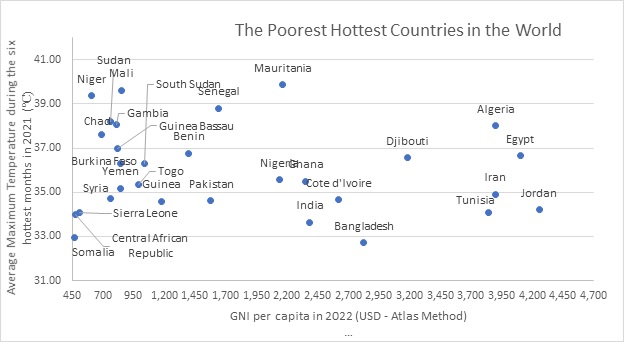
Figure below illustrates the poorer countries that are facing the hottest climate. They face hostile climate conditions which hamper their productivity, health and agility.
Nonetheless, climate challenge is not just a phenomenon impacting the poor. The Middle Eastern countries, South East Asian countries and some countries in the Far East also face climate challenge. It affects health, biodiversity and even food production and availability.
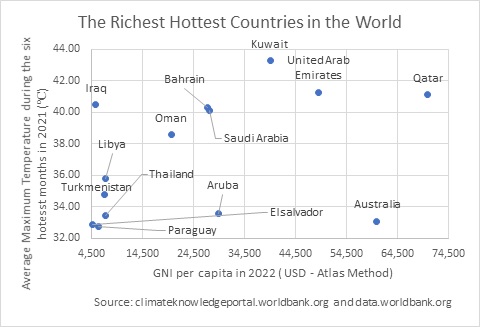
The graphs above illustrate the 43 hottest countries in the world, where the average maximum temperature during the six hottest months exceeded 33 ℃ in 2021.
The first graph depicts countries which as per the World Bank are clubbed as the lower-income and lower-middle-income economies. To be more specific, where the average annual income earned by the resident of the country is less than $4,465.
The countries located in the northwest portion of the graph, namely Chad, Niger, Sudan, Mali, and Gambia deserve special attention. They have low levels of income accompanied by exorbitantly high temperatures. One can assume that with such meager incomes, they cannot afford a temperature-ameliorating lifestyle, for example, the luxury of air-conditioners.
It would be worthwhile to take a look at the electricity prices prevalent in these countries. As per 2021 data released by cable.co.uk, save for Sudan, electricity in Chad, Niger, Mali, and Gambia is quite costly, in fact, costlier than in Pakistan.
In Pakistan, the electricity price is $0.081 per kilowatt hour (kWh) while in Chad, Niger, Mali, and Gambia, it stands at $0.174, $0.117, $0.375, and $0.20 respectively. These regions can be termed as the most climatically-challenged countries with people facing average maximum temperatures between 37℃ and 41℃ and with no possibility of using electricity generously.
Low electricity prices are not a sufficient condition. In Sudan where electricity rates are only $0.014 per kWh, only 33% of the population has access to electricity.
There are more countries that are fighting the climate battle. Burkina Faso, Yemen, Togo, and South Sudan are all poor countries with average maximum summer temperatures between 35 ℃ and 37 ℃. Electricity is quite expensive in South Sudan ($0.36 USD per kWh) – one of the highest rates in the world. For Burkina Faso and Togo, the per kilowatt hours rates are $0.22 and $0.14 respectively. Air conditioners must surely be a commodity only the rich can afford with ordinary people only skimping on their electricity consumption.
The rest of the countries in the graph are not posing a bright picture either. In Mauritania, the average maximum summer temperature was close to 40℃. A GNI per capita of $2,160 puts Mauritania in the category of a lower-middle-income country. Electricity tariffs are $0.13 per kWh, higher than $0.081 per kWh in Pakistan. Life must be challenging for anyone not able to fend off the summer strikes.
What about Pakistan, India, and Bangladesh? Which country is more livable, summer-wise? Bangladesh has a GNI per capita of $2,820, higher than India’s $2,380 and Pakistan’s $1,580. The average maximum summer temperature in Bangladesh in 2021 was 32.71℃, lower than India’s 33.64℃ and Pakistan’s 34.61 ℃.
Moreover, electricity is the costliest in India among the three with a per kilowatt hour rate of $0.092. In Pakistan and Bangladesh, it rounds off to $0.081 and $0.08 respectively. At least as per these numbers, Bangladesh ranks better on the climate scale than the other two.
Now, let’s take a look at the other graph which illustrates the 14 hottest richest countries in the world. Saudi Arabia, Qatar, Kuwait, United Arab Emirates, and Oman have average maximum temperatures between 39℃ and 43℃. These high numebrs do not create havoc in the lives of people given the rich living standards. The electricity prices are one of the lowest in Kuwait ($ 0.033 per kWh), Qatar ($0.036 per kWh), Bahrian ($0.045 per kWh), and Oman ($0.052 per KwH). Having spent a big part of my childhood in Jeddah, Saudi Arabia, I can recall our 24/7 consumption of air-conditioners. The affordability of electricity in Saudi Arabia in the 90s was our bastion from the blazing sun outside.
The plight of these people is a difficult thing to put an end to considering the complexity of the availability and affordability issues of electricity. Of the fossil fuels, coal is the least expensive. Nearly all renewable energy resources like wind and solar are relatively inexpensive.
An ideal situation would be where the the governments subsidize production through cheap sources and distribution of electricity and purchase/maintenance of air-conditioners but this is a utopian thought. The governments in developing countries are already facing huge debts and almost always running fiscal deficits.
Because of mere fate, a lot of people in the world, including Pakistan, have ended up in a position where they bear the torment of heat without much to do about it. They can not operate air-conditioners even when the temperature flares up and beyond the 35℃. Many do not even have one. “A man has only a certain capacity for battling with fate’, said Wodehouse. Well! this capacity is amazingly high in some people. But, there is still a long waiting period.
Categories: Articles on Islamic Economics
 Islamic Economics Project