

Waleed A.J. Addas
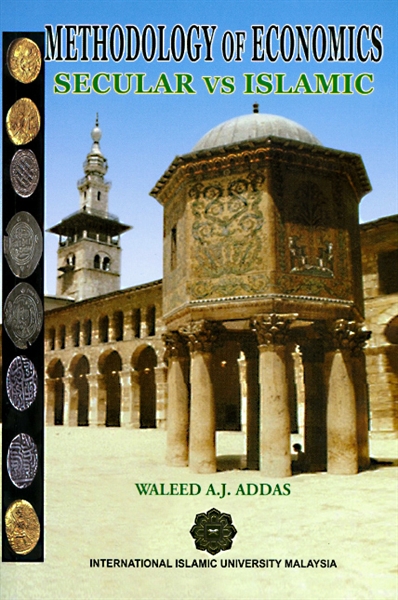
The book “Methodology of Economics: Secular Versus Islamic” by Dr. Waleed A. J. Addas examines the philosophical foundations and criteria for evaluating both secular (mainstream/orthodox) and Islamic economics.
The author clarifies the nature and role of secular methodology, demonstrating that how the Islamic methodology differs, and assesses the implications of these differences for the scope and nature of Islamic economics.
The author asserts that Islamic economics is currently the result of applying Islamic rules and injunctions (Fiqh) to the secular economic framework, and is not yet a separate discipline that fully replaces secular economics. The author notes that methodology is a messy and confusing area in both fields. He highlights that in Islamic economics, it is often wrongly treated as a research design or work plan.
The author explains that economics is usually called ‘science’ and is seen to be built for achieving its objectives on some perception of rationality. Methodology is the ‘theory of theories’; in the field of economics it refers to the “process economists use to authenticate the knowledge about economic phenomena”.
Economics is both a descriptive and prescriptive discipline. Methodology is important to evaluate the performance of economics from outside the discipline and suggesting what economists should be doing in light of a priori objectives.
The book’s comparative analysis focuses on key points of departure between the two methodologies, which are rooted in their fundamental system of belief and worldview. The book contrasts the secular worldview with the Islamic worldview.
The author explains the nature and significance of worldview as a conditioner of human conduct. In this context, the common view of the ‘economic man’, as a rational-utility maximizing agent; pursuing his self-interest in a single-minded way is critically reviewed. Adam Smith considered man as he is; dominated by self-love, but without much altruistic concern for others.
The secular view centres on the ‘economic man’ as a rational, utility-maximizing agent pursuing self-interest. Islamic economics modifies this by shifting the focus from self-interest to ‘God’s Interest’ (redefined self-interest in the life and hereafter), meaning the concept of man and his objectives are redefined by Islamic teachings.
The discussion focuses on the roles of reason and revelation in generating knowledge and explaining economic reality. In fact, the distinction between reason and revelation is of Western import. The author examines the limitations Islam imposes on the use of pure reason in economic decisions. The book reveals the contemporary recognition that secular economics is not entirely value-free, contrary to earlier claims.
This author differentiates methodology (the philosophical evaluation) from methods (the practical techniques). The author is not apprehensive about the use of the experimental approach, empirical testing, and econometric analysis. He supports the view that quantitative studies must be guided by theory and methods can be used to empirically verify the claims of theory in practical behaviour. However, methods alone are not enough to give birth to theories or ideation. The author clarifies that the theory precedes the statistical investigation in deductive approach.
The author maintains that Islamic economics is fundamentally a normative science—concerned with ‘what should be’—although it contains positivist elements. Since Islam is seen as a ‘way of life’, Islamic economics is also viewed as having a significant art aspect with policy overtones.
The author discusses the tensions in methodology of Islamic economics among the scholars. He thinks that a clearer understanding of the methodological foundations is crucial for the survival and growth of Islamic economics. Islamic economics is currently the result of applying Fiqh to a secular economic framework (a “step-by-step approach”), thus making it dependent on its secular counterpart.
The continued use of a step-by-step approach (modifying secular concepts) rather than an all-or-nothing replacement approach makes it currently impossible to declare the full independence of the Islamic discipline from its secular counterpart. The methodology helps chart a course for a universal ‘Theory of Knowledge’ by defining the bases or roots for theoretical economics.
The author is also critical of Islamic economics literature on methodology of economics. He thinks that when criticism is made, it is dismissive, not constructive. When integration is pursued, it also goes to the other extreme by uncritically embedding elements from secular economics in Islamic economics which require careful critical analysis first.
He states that works on methodology in Islamic economics are sketchy and incoherent. The reason for this state of affairs is that positions in many areas of Islamic economics remain infirm, even untouched. For example, there is confusion on such basic issues as the scarcity of resources, pursuit of self-interest, maximizing behaviour on the part of economic agents, bases of interest-free finance and so on.
He writes that “much of what one comes across is dotted with ill-conceived half-baked ideas, confusing explanations, and rhetoric. Again, there often is a lack of understanding of the issues involved or their adequate analysis.” He also mentions the paradox in Islamic economics concerning the methodology. Should one adopt a step-by-step or an all-or-nothing approach to the issue?
However, the book does not give a concrete work plan either which can be followed as a blueprint of methodology in Islamic economics. How the Masjid Al-Shariah can be translated in analytical framework, development of theories and testing of theories? Should Masjid-e-Shariah be integrated in policy discussions directly without having a redefined micro-founded theoretical model.
Furthermore, religious compliance or its purity depends on quality of behaviour and unobservable intentions. How an unobservable internal state like intention can be incorporated in empirical or theoretical models if positive analysis is to be carried out in Islamic economics as well.
Overall, it is an enlightening book to compare the methodology of economics from secular and Islamic worldview and to foster discussion on what should be the nature and scope of economics and how to integrate revealed and human sciences if that integration is suitable, desirable and beneficial.
The author hopes that Islamic economics under Islamic elements of methodology can not only enrich the mainstream economics, rather encompass and eclipse it for positive as well as normative discussions about economic phenomena.
Categories: Articles on Islamic Economics
 Islamic Economics Project