

| Prof. Mohamed Aslam Haneef |
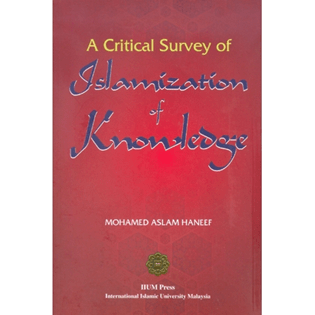
The concept of Islamization of Knowledge (IoK) emerged in the late 20th century as a response to the perceived intellectual malaise of the Muslim Ummah. While unified by the goal of reconciling modern secular sciences with Islamic revelation, scholars differ significantly in their methodologies and philosophical starting points.
Al-Faruqi is perhaps the most famous proponent, having founded the International Institute of Islamic Thought (IIIT). He identified the dualism of education (secular vs. religious) as the root of Muslim decline. He proposed a 12-step work plan that involves mastering modern disciplines, mastering the Islamic legacy, and then recasting modern knowledge within an Islamic framework based on the principle of Tawhid (the oneness of God). Faruqi’s 12-point work plan is as follows:
- Mastery of modern disciplines: Muslim scholars must first achieve a thorough understanding of the contemporary Western academic disciplines.
- A detailed survey of the disciplines: This involves a comprehensive analysis of the existing body of knowledge within each discipline, identifying its history, methods, principles, and assumptions.
- Mastery of the Islamic legacy: The Anthology: This requires an extensive survey and categorization of the classical Islamic intellectual heritage relevant to all fields of knowledge.
- Mastery of the Islamic legacy: The Analysis: An in-depth, critical study of the collected Islamic legacy to understand its strengths and weaknesses in the modern context.
- Establishment of the specific relevance of Islam to the modern disciplines: Determining how Islamic principles and values apply specifically to the subject matter of each modern discipline.
- Critical assessment of the modern disciplines: Evaluating the modern Western disciplines from an Islamic perspective, identifying elements that contradict Islamic teachings (such as secularism or materialism).
- Critical assessment of the Islamic legacy: Critically examining the traditional Islamic knowledge body and identifying areas where it may have fallen short in addressing modern challenges.
- Survey of the major problems of the Muslim Ummah: Identifying the social, economic, political, and cultural challenges facing the global Muslim community.
- Survey of the problems of humankind: Assessing the general problems confronting all of humanity.
- Creative analysis and synthesis: Bridging the gap between the Islamic legacy and modern knowledge to find solutions for the identified problems of the Ummah and humanity.
- Recasting the disciplines under the framework of Islam: Reformulating the entire academic discipline, rewriting textbooks and curricula to reflect the newly integrated Islamic worldview.
- Dissemination of Islamized knowledge: Publishing books, papers, and articles to share and implement this newly structured, Islamized knowledge globally.
However, critics like Dr. Ziauddin Sardar argue that his approach is too ‘reconstructionist’ and bureaucratic, sometimes resulting in a superficial labelling of secular subjects with Islamic terminology rather than a deep epistemological overhaul.
Dr. Ziauddin Sardar maintains that knowledge is a social construct and that ‘Islamic Science’ must be built on the ethical parameters of Islam (e.g., Khilafah, Adl, Istislah). He argues for a total paradigm shift rather than just integrating Western subjects. He views Islamization as a contemporary project to solve current global problems using Islamic values.
He argues that modern Western disciplines are not neutral vessels into which one can simply pour Islamic values. Instead, they are built on specific Western perceptions, ideologies, and historical experiences (such as capitalism or secularism).
Dr. Sardar posits that knowledge is not a universal entity but is deeply rooted in culture and civilization. He argues that different civilizations will—and should—produce different sciences. In his view, Western science is just one ‘way of being human’ and one ‘way of knowing’.
Unlike traditionalists who may look solely to the past, Dr. Ziauddin Sardar is a futurist. He views Islamization as a continuous process of moving towards a moving target. It is not a one-time academic task but a dynamic effort to solve contemporary global crises—such as environmental degradation and social inequality—using an Islamic ethical lens. For Dr. Sardar, the validity of knowledge is measured by its benefit to the community (Ummah) and its alignment with ethical objectives (Maqasid).
On the other hand, Al-Attas provided the earliest philosophical framework for IoK, predating Faruqi’s formalization. He views the problem as the ‘de-Westernization’ of knowledge. For him, knowledge is not value-neutral; Western knowledge is infused with secularism and dualism. He emphasizes the Islamization of language and the concept of Adab (right action/knowledge). He argues for removing foreign Western elements from the core of knowledge and replacing them with Islamic metaphysics. Nonetheless, his approach is deeply philosophical and mystical (Sufi-oriented), which some find difficult to translate into a practical curriculum for natural sciences.
According to Al-Attas, the first step towards Islamization involves critically examining modern Western knowledge to identify, separate, and remove its inherent non-Islamic, secular elements and key concepts. These foreign elements include the concept of dualism (separation of mind/body, intellect/reason, etc.), secular ideology, the doctrine of humanism and interpretations of origins and theories that deny divine intervention.
Al-Attas contends that after the purification process, the knowledge that is ‘freed’ from the Western biases is then imbued with fundamental Islamic principles and key concepts, such as the concept of God (Tawḥīd), the concepts of knowledge (‘ilm and ma’rifah), wisdom (ḥikmah), and justice (‘adl), the concept of right action (‘amal as adab – correct conduct) and the purpose of human life as a servant and vicegerent of Allah.
In contrast, Prof. Syed Hossein Nasr approaches Islamization through the lens of ‘Sacred Science’. He argues that modern science is fundamentally flawed because it is devoid of the sacred and purely quantitative, leading to ecological and spiritual crises. He advocates for an approach to science as a way of contemplating the ‘signs’ (ayat) of God in nature.
Taha Jabir al-Alwani shifted the focus toward a new methodology of thinking. He proposed combining of the two readings, i.e. the reading of revelation (the Qur’an) and the reading of the universe (Nature/Humanity). He moved away from al-Faruqi’s rigid 12-step plan toward a more fluid reform of the Muslim mind (Islah al-Fikr), emphasizing Ijtihad (independent reasoning) and the higher objectives of Shari’ah (Maqasid).
Among the Islamic modernists, Dr. Fazlur Rahman Malik Rahman was critical of the formal Islamization movement, considering it a defensive reaction. He argued that the Qur’an provides a general moral-social direction, not a detailed scientific manual.
He proposed a ‘double movement’ theory. First, understand the Qur’anic message in its historical context; second, apply its essential ethical principles to the modern situation. He believed in mastering modern tools without necessarily Islamizing the data itself.
The book is a succinct summary of the major thoughts in Islamization of knowledge and the noted author provides a clear demonstration of ideas and how they contrast with each other.
An equally useful contribution of the book is the illustration of the different views in flowchart diagram to ease understanding through illustrations. Finally, the book also contains abstracts of seminal works together with a useful and relevant bibliography for interested readers.
Categories: Articles on Islamic Economics
 Islamic Economics Project