

| Mona Abul–Fadl |
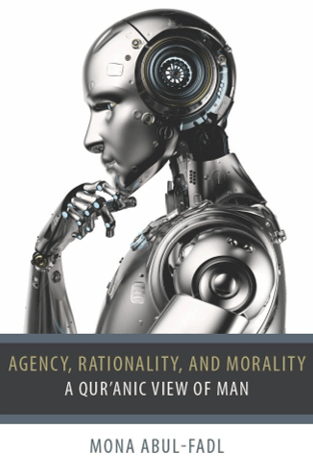
Mona Abul-Fadl’s monograph, Agency, Rationality, and Morality: A Qur’anic View of Man is a profound intellectual
intervention in contemporary philosophical, theological, and civilizational discourse. It addresses the profound spiritual and moral crisis of modern civilization. It sets out to examine the modern human condition through the lens of the Qur’anic paradigm.
Her central thesis posits that secular modernity, despite its extraordinary technological and material triumphs, has ultimately relegated man to a state of decentered alienation, nihilism, and anomie precisely because it divorced itself from spiritual tradition and divine guidance.
By contrasting the anthropocentric and materialistic frameworks of the modern West with a theocentric humanist worldview derived from the Qur’an, Abul-Fadl constructs a rigorous defense of human agency, rationality, and moral responsibility, aiming to chart a path toward global cultural renewal and the reintegration of the human self.
The foundational premise of Abul-Fadl’s critique targets the trajectory of modernity, which she traces back to the shifting intellectual currents of the European Enlightenment and the Renaissance. While the Renaissance and subsequent centuries initially celebrated the liberation of man from the oppressive constrictions of a dogmatic religious magisterium, this liberation mutated into an unbridled anthropocentrism.
Man arrogated to himself the measure of all things, shifting the agency and responsibility for life and mortality away from the divine to the human ego. However, as materialism triumphed over spiritual transcendence, man was systematically naturalized and simultaneously denaturalized. Stripped of his metaphysical essence, the human being was reduced by behavioral sciences and technocratic systems to a mere biological organism, a chemical compound, or a corporate abstraction ready for mass manipulation and control.
In the secular worldview, the cosmos is seen as an indifferent or hostile wilderness to be subdued, exploited, or overcome through technology. As per the Islamic worldview, the cosmos is purposefully created, balanced (mīzān), and subjected (taskhīr) to human care in a spirit of reverence and gratitude (shukr).
Abul-Fadl argues that this downward spiral inevitably converted society into a graveyard of humanity, leaving man stranded as a ‘cosmic orphan’ in a vast, forlorn, and meaningless universe. Making man the ultimate measure of reality does not elevate him; it degrades him into a mechanical, biological object subjected to social engineering and existential alienation.
To counter this modern impasse, Abul-Fadl proposes a systematic exploration of Islamic sources, asserting that the Qur’an offers a comprehensive, coherent, and profoundly illuminating view of human existence. In stark contrast to the autonomous, self-trapped entity of Western philosophy, the Islamic paradigm defines man (insān) as a relational entity. Man occupies a privileged position at the crown of creation, yet he exists within a web of benign and reciprocal dependencies sustained by divine Mercy and Compassion. He is not an abandoned cosmic orphan, but a conscious being who issues forth from the primal origin of Adam, charged with a universal trust (amānah) and a divine mandate of vicegerency (khilafah).
Constitutionally, man is a composite of material and divine elements, combining an earthly physical framework with an innate disposition (fitrah) that inclines him toward truth, balance, and righteousness.
Abul-Fadl emphasizes that this view rejects any dualistic split between the physical and the spiritual; instead, human existence is framed by an integral unity where reason (aql) and revelation (wahy) operate in complete harmony.
Central to Abul-Fadl’s analysis is her deep interrogation of human agency, which she anchors in the twin faculties of cognition and volition. Unlike deterministic systems of thought—whether materialistic, scientific, or historicist—the Qur’anic view insists that man is a free moral agent endowed with the capacity to discern (idrāk/tamyīz) and to choose (ikhtiyār) between alternative paths.
This freedom is not an absolute, ungrounded autonomy, but a responsible freedom exercised within the parameters of a primordial Covenant (mithāq) established between the Creator and humanity. Referencing the famous Verse of the Trust, Abul-Fadl explains that when the heavens, the earth, and the mountains refused the burden of the amānah out of fear, man willingly bore it, albeit prone to injustice and folly through his initial ignorance of its immense consequences. This trust encompasses human reason, volition, and moral responsibility, culminating in the vocation of the khilafah. Consequently, man’s freedom is inextricably linked to accountability; his choices carry eternal weight, and his moral agency forms the cornerstone of his trial and tribulation (ibtilā) on earth.
Abul-Fadl devotes considerable analytical rigor to examining the harmony between human rationality and divine revelation, contrasting it sharply with the epistemological fractures of Western thought. She argues that true knowledge begins with divine Guidance, which acts as a luminous compass (dhikr, bayān) illuminating the mind and guiding the self. Rather than imposing an authoritarian suppression of freedom, revelation appeals directly to human reason and the inner core of the heart (qalb), which serves as the seat of intentionality and the processor of divine signals.
Freedom and rationality are not ends in themselves; they are divinely bestowed capacities that carry the responsibility of moral discernment and adherence to the primordial covenant.
In the Islamic episteme, reason points beyond itself to revelation, and revelation fulfills reason by rescuing it from endless, ungrounded speculation and the paralyzing traps of skepticism. This epistemological integration shields humanity from the hubris of self-deification and the absurdity of nihilism, offering instead an unshakable foundation of certainty (yaqīn) that anchors human thought and action in the objective reality of the Truth (al-Haqq).
Furthermore, Abul-Fadl meticulously unpacks the ontological and historical account of human creation, contrasting the Qur’anic narrative of the descent (khurūj) from Paradise with the Western theological doctrine of the Fall. In the Qur’anic version, Adam and Eve are a joint account from start to finish, sharing absolute ontic parity, mutual dignity, and equal moral capacity without any stigma of an ‘original sin’ or female complicity.
The descent to earth was not a mark of permanent debasement, hopeless abandonment, or a punitive purgatory, but a pre-ordained transition to a stage of trial, achievement, and pilgrim’s progress. Human terrestrial life is an intended arena for growth, achievement, and moral testing (ibtilā’), sustained by recurring divine guidance through prophetic messengers.
Human beings were equipped with the fitrah, divine guidance, and the capacity for sincere repentance (tawbah) and return (awwāb) to overcome their vulnerabilities. This framework completely redeems human nature from inherent corruption, establishing an optimistic, life-affirmative ethos where recovery, moral reform, and spiritual growth are always within reach of a willing soul.
She argues that because all human beings originate from a single soul (nafs wāhidah) and share an identical devotional status of submission to the One Creator (ubudiyyah), fundamental human equality is an intrinsic, divinely imparted reality rather than a belated, cosmetic, or utilitarian social construct.
In this theocentric framework, differences of race, color, ethnicity, or gender do not dictate moral superiority or inherent privilege; rather, the only true criterion of distinction before God is piety and God-consciousness (taqwā).
Society is structured upon the principles of complementarity, mutual acquaintance (ta’āruf), compassion (marhamah/mawaddah), and the collective moral duty of believers—men and women alike—to enjoin the good and forbid the evil. The Islamic mandate of khilāfah fundamentally rejects exploitative dominion over nature and other human beings, demanding responsible trusteeship subject to divine limits (ḥudūd Allāh).
Human rejection of divine truth is not an act of rational dissent, but an irrational obstruction caused by preconceived prejudice, arrogance, or willful resistance—metaphorically described as “locks upon hearts”.
In her concluding reflections, Abul-Fadl reiterates that the contemporary relevance of the Qur’anic view of man lies in its ability to rescue modern humanity from its self-inflicted spiritual starvation. Secular humanism, she asserts, can at best achieve the negative task of dismantling ancient idolatries and disenchanting the world, but the moment it attempts to construct an ethical system independently of divine transcendence, it collapses into philosophical incoherence and practical subversion.
Only an Islamic humanism, which harmonizes reason with revelation and balances human autonomy with wholesome dependence on the Creator, can successfully restore meaning, community, and moral integrity to human life. Ultimately, Abul-Fadl’s treatise urges modern intellectuals to look beyond the narrow confines of materialist paradigms and rediscover the timeless, luminous blueprint of man as an honoured vicegerent of God on earth.
Man is physically and spiritually integrated into the cosmos. Originating from dust and water and sustained by divine design, humanity shares affinities with all created things. Rather than being an alienated orphan in a hostile universe, the human being attains inner peace and psychic integration by aligning with a universe that is already in perpetual, harmonious worship of God.
Categories: Science and Religion

