

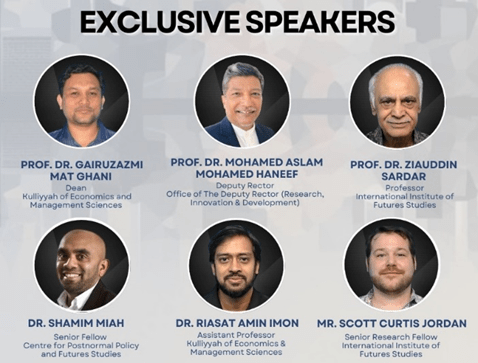
Key Takeaways & Roundup of IIUM Symposium on December 5, 2025
Department of Economics
Kulliyyah of Economics and Management Sciences
International Islamic University Malaysia
IIUM’s Vision 2077: Toward a Just and Balanced Economy (Al-Iqtisad Al-Wasati)
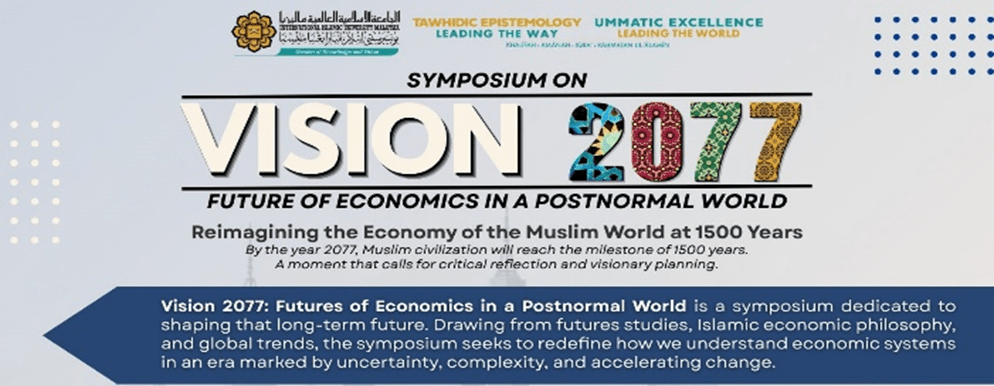
Vision 2077 represents a paradigmatic shift in socioeconomic planning, moving away from traditional linear forecasting toward a robust Futures research framework. Initiated by the late Professor Emeritus Tan Sri Dr. Mohd. Kamal Hassan on October 1, 2019, the project seeks to conceptualize a ‘New Hijrah’ for the Muslim Ummah. This presentation specifically delineates the Economics and Finance Cluster, proposing the ‘Al-Iqtisad Al-Wasati’ (School of Moderation and Balance) as a counter-narrative to the prevailing neoclassical economic models that have resulted in systemic inequality, financial instability, and environmental degradation.
The Crisis of Mainstream Economic Paradigms
The impetus for Vision 2077 is rooted in a profound critique of the current global and local economic reality. The IIUM Vision 2077 report identifies several ‘foundational challenges’ that necessitate a radical departure from the status quo:
- Systemic Failure of Wealth Distribution: The prevailing system is characterized by rising inequality and market-feudalism, where the economy serves a narrow elite rather than the collective good.
- Decoupling of Finance and Reality: A critical instability arises from the financial sector’s disproportionate growth relative to the real sector, leading to frequent economic volatility.
- Value Mismatch: Mainstream economics prioritizes satiation and growth over purposefulness, justice, and ethics.
- Neo-colonial Trappings: The current frameworks perpetuate institutionalized dependence and lack moral or spiritual dimensions in their incentive structures.
These failures necessitate not just minor reforms (Islah) but a comprehensive renewal (Tajdid) of the economic philosophy guiding the nation.
Methodological Framework: Traditional vs. Futures Research
A core contribution of IIUM’s Vision 2077 is its methodological transparency. It contrasts Traditional Research, which is often constrained by disciplinary boundaries and focused on explaining how reality works through variable modelling, with the Futures Approach. Unlike traditional research that merely explains how reality works through identifying variables, the Futures approach focuses on an ‘Open Narrative’. It moves from ‘Forecasting’ (predicting trajectories) to ‘Scenario Planning’, where the goal is to actively choose and create an ideal future through policy.
The Futures Research Outlook
The discourse in the symposium adopted an open narrative to understand how past and present realities were constructed. It analyses ‘push-pull factors’, such as financialization, ethnic polarity, and high national debt. It recognizes that variations in these factors induce different potential realities. It emphasizes the need to choose a preferred future rather than passively accepting a forecasted trajectory.
Al-Iqtisad Al-Wasati (The Preferred Future)
The ‘Preferred Future’ is defined by the Al-Iqtisad Al-Wasati model, which seeks moderation, balance, and ‘Justice for All’ across economic, social, and spiritual dimensions. It requires a bottom-up organic development of Islamic economic values and theories. These values must be integrated into production, finance, environment, governance, and distribution. The
ultimate goal is a harmony between economic, social, and spiritual dimensions. This vision is operationalized through five key economic domains:
- Production and Trade
The objective is to break free from the low-cost labour model. The strategy to achieve this objective aims at transitioning to technology-augmented, circular, and sharing economies that incorporate social and ecological values. Furthermore, it is vital to ensure food security and sustainable production systems.
2. Integrated Financial System
The objective is to reintegrate the financial sector with the real economy. To make it happen, it is important to move towards equity-based financing (risk and profit-sharing) and establishing the government as the sole money-creating authority. As a result, what is to be achieved eventually is elimination of financial fraud and high debt components in aggregate finance.
3. Equitable Distribution
The objective is to eliminate intra-ethnic and spatial inequalities. To realize achieving that objective, it is pertinent to implement a progressive tax system and enhance the role and penetration of ‘Third Sector’, i.e. Waqf and Zakat institutions. Through committed, sustained and institutionalized efforts, it is possible to achieve zero extreme poverty and ‘dignified living’ for all citizens. This will help in achieving the often cherished goal of need fulfilment in Islamic economics discourse.
4. Resilient Environment
In this dimension, the objective is to overcome the reliance on fossil fuels and halting habitat destruction. It rests on internalizing environmental costs where economic agents view the environment as sacred and willingly incur higher costs for greener trade-offs. Concrete and time-bound targets are important, such as reducing Greenhouse Gases (GHG) by 25%-40% through green quotas and restoration.
5. Just Governance
In this aspect, the objective is to eradicate systemic corruption and race-based politics. It depends on transitioning to value-based politics supported by full transparency and technological accountability.
Alternative Scenarios: The Risks of Inaction
The symposium warned against ‘Less Preferred Alternatives’ through the lens of Ifrat & Tafrit (Extremes) manifested in:
- Liberal Markets: Entrenched corporatization, extreme wealth concentration, and crony capitalism.
- Authoritarian State: A totalitarian regime that restricts freedoms to serve a small clique.
- Doting Government: A pseudo-welfare state that creates overreliance on social insurance and destroys the work ethic.
- Doing Nothing: Persistence of ethnic divisions leading to social unrest and regional obsolescence.
Implementation Strategy: Back-casting and Road-mapping
The transition to Vision 2077 is not viewed as a linear progression but as a ‘Back-casting’ exercise—defining the ideal 2077 state and working backward to the present.
| Phase | Timeline | Key Strategic Actions |
| Foundation | 2023–2029 | Overcoming neoclassical challenges; initiating the IIUM School of Economics; adopting new social narratives. |
| Transition | 2030–2050 | Internalizing Islamic values and frameworks; economic agents begin causing systemic change. |
| Realization | 2051–2077 | Full integration of Islamic value systems with social values; achieving socioeconomic justice. |
Conclusion
Vision 2077 is an ambitious intellectual project that successfully identifies the ontological and epistemological shortcomings of modern economic policy. By utilizing Futures Thinking, it avoids the trap of forecasting the past and instead empowers policymakers to design a future rooted in the Maqasid al-Shariah (objectives of Islamic law). However, the path forward requires significant institutional buy-in. The symposium outlined several immediate next steps:
- Engaging external stakeholders, including government ministers and policymakers.
- Collaborating with global partners like the Maqasid Institute (USA) for deeper financial perspectives.
- Developing formal position papers and a comprehensive roadmap.
The ultimate success of Vision 2077 depends on its ability to move from an academic ‘Educational Curriculum Development Strategy’ into a functional national policy framework that can withstand the push-pull factors of a globalized economy.
Categories: Articles on Islamic Economics
 Islamic Economics Project