

Baqir Us Sadr
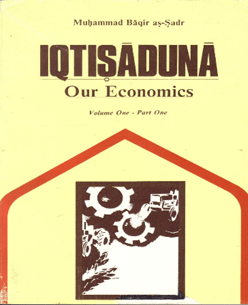
Iqtisaduna (Our Economics), authored by the preeminent Islamic scholar and philosopher Muhammad Baqir al-Sadr, remains a towering achievement in modern Islamic intellectual history. This foundational text does not merely suggest a religious alternative to global financial systems; it provides a rigorous, academic deconstruction of the two major economic doctrines of Western thought—Capitalism and Socialism.
Al-Sadr observed that while many Islamic nations had successfully sought political independence from European colonial domination, they remained paradoxically trapped within European intellectual and economic frameworks. His work was an attempt to break these invisible chains, offering a comprehensive system rooted in Islamic ontology and social justice.
The Philosophical Deconstruction of Dialectical Materialism
The book begins with an incisive academic criticism of dialectical materialism, the philosophical backbone of Marxist thought. Al-Sadr argues that history is an incredibly complex phenomenon that cannot be reduced to a single driving force, such as the economic factor or the means of production.
He asserts that various other elements, including religious convictions, political structures, and social dynamics, play primary and often independent roles in shaping human destiny. He challenges the foundational logic of materialism by pointing out that it cannot explain the “first push” of the universe or human development without acknowledging a non-material or Divine cause. For al-Sadr, the materialist view is a narrow lens that fails to capture the multidimensional nature of human existence.
Marxism famously claims that the ‘antithesis’ arises naturally from within the ‘thesis’, leading to a revolutionary transition. However, al-Sadr meticulously notes that historical transitions, such as the shift from Feudalism to Capitalism, did not always follow the revolutionary, dialectical path Marx predicted. Many of these shifts occurred gradually and evolutionary, often without a sudden renewal of productive forces.
Furthermore, he identifies a logical contradiction in the Marxist endgame. If everything is in a constant state of flux and every stage must produce an antithesis, the final Communist stage should also evolve into something else. Yet, Marxism treats this stage as a final, static end to history, which al-Sadr argues is a philosophical inconsistency.
The Primacy of the Human Intellect
In his critique of the relationship between the economic base and social superstructures, al-Sadr challenges the notion that religion, politics, and ideology are merely by products of the means of production.
He poses a fundamental question: why did humanity start productive activity in the first place? He points out that while animals face the same material needs as humans, they have never developed productive forces or tools. From this, al-Sadr concludes that the origin of economic activity lies in human intellect and the capacity for planning, rather than in the material forces themselves.
He argues that the development of a tool is essentially the product of human thought and experimentation, placing the human mind as a factor higher than the tool it creates. In this view, the tool is the embodiment of an idea, not its creator or its master.
Expanding on this, al-Sadr challenges the Marxist and Ricardian methodological focus on labour as the sole source of value. This perspective, he argues, incorrectly excludes the positive roles of nature and psychological factors.
He maintains that human desire and utility objectively influence exchange value just as much as labour. For instance, if the collective desire for a commodity falls due to a shift in political or religious ideology, its exchange value will drop even if the amount of labour required to produce it remains constant. This demonstrates that value is not a purely mechanical measurement of time and effort but is deeply tied to the human condition and social context.
Scarcity, Desire, and the Theory of Value
To further dismantle the labour theory of value, al-Sadr uses the example of scarce natural resources. A diamond found by chance requires no labour to exist, yet it commands an immense price. This proves that scarcity and human desire—psychological factors—are the true determinants of value. He notes that while cotton and silk cloth have different physical properties and require different amounts of labour to produce, their equality in exchange is often due to a common psychological trait: the human desire to possess them.
If the collective desire for a product vanishes, its value drops to zero regardless of how much labour was expended. Marxism, he argues, ignores the inherent value of raw materials and natural resources, which possess value based on their scarcity rather than the labour required to extract them.
Al-Sadr also addresses the role of natural ability and artistic talent in the economy. He argues that the time spent on a project cannot explain the value of products involving unique human gifts, such as a charming picture or a piece of fine art. In these cases, the quality of the work creates an additional value that labour-time alone is fundamentally incapable of measuring.
This leads to his critique of the predictions of dialectical materialism as illustrated by historical contradictions. He argues it is logically absurd to expect an arbitrary and absolute government, such as the one seen in the USSR, to be the prelude to its own disappearance. Instead of shrinking, the socialist state became an absolute dictatorship, proving that the dialectic failed to predict the reality of human power dynamics.
The Critique of Capitalist Freedom
On the origin of Capitalism, al-Sadr argues that the system did not arise from a revolutionary burst of productive forces but rather from external factors like the discovery of mines, the exploitation of colonies, and the growth of international trade.
He challenges the Capitalist assertion that absolute economic freedom is a universal scientific necessity. Instead, he views it as a specific cultural choice of the Western ‘European man’.
He critiques the emphasis on absolute individual freedom, which often prioritizes the whims of the individual over the collective welfare of society. This unbridled freedom, he warns, leads to the concentration of wealth and the means of production in the hands of a small group.
The Capitalist obsession with profit is another point of contention for al-Sadr. He observes that profit flows abundantly to the owners of capital, often at the direct cost of social justice. He points out that the Capitalist mode of distribution fails to provide for those in need because it is based on market power rather than a moral framework of justice.
Because Capitalism treats economics as a cold science of scarcity, it loses sight of the human element. This leads into al-Sadr’s vital distinction between the ‘Science of Economy’ and ‘Economic Doctrine’.
Science, Doctrine, and Social Equilibrium
According to al-Sadr, Economic Science is a descriptive field that seeks to study economic life and the causal links between events. In contrast, Economic Doctrine refers to the normative framework a society chooses to organize its life and solve practical problems. Unlike science, which discovers existing reality, a doctrine plans and creates a system based on moral, social, or ideological values. Al-Sadr argues that Islamic economics is primarily a doctrine, not a science. It is a set of rules intended to achieve social justice and solve economic problems according to Islamic values. It does not seek to discover ‘natural laws’ of the market but to impose a just order upon it.
The primary economic problem in Islam, as presented in Iqtisaduna, is not the relative scarcity emphasized by Capitalism or the mode of production emphasized by Marxism. Instead, the problem is injustice in distribution. To combat this, al-Sadr proposes ‘Social Equilibrium’.
This concept does not mean total equality of wealth for everyone, but rather that every individual is guaranteed a standard of living commensurate with human dignity. This ensures that wealth does not ‘circulate only among the rich’, creating a society where the gap between classes is narrowed by moral and legal obligations.
Categories: Articles on Islamic Economics
 Islamic Economics Project