

Dr. Farrukh Habib
Founder & CEO, Azka Advisors (UK)
Co-Founder of Alif Technologies (Dubai)
https://www.linkedin.com/in/drfarrukhhabib
Before asking whether a crypto asset is halal, we need to know what type of mal it is in Shariah, because the type decides which Fiqh rules apply. Market labels such as “utility,” “payment,” or “RWA” describe what a token does, or how a regulator treats it, not what it is in Shariah. The Shariah Crypto Classification Framework (SCCF), published here for the first time, sorts every crypto asset that qualifies as mal, starting with one question: is it money or not? The answer tells you which rules govern the asset; whether a particular asset is halal or haram is a separate question that comes later in the series.
A. Why a New Classification Is Needed
The crypto market already has plenty of labels: payment token, utility token, security token, RWA token. These labels were built for other purposes. Some describe what a token does. Others are chosen for regulatory, legal, or tax convenience. Shariah needs something different. It needs to know what type of mal an asset is, because each type follows its own body of Fiqh rules. Two examples show why this is important.
Tokens backed by physical gold or silver are usually labelled “RWA tokens” or “tokenized commodities.” That label puts them in the same group as tokenized oil, wheat, or real estate. In Shariah, however, gold and silver are money by nature. So, a token backed by specific, physical gold is money too, and exchanging it follows the Fiqh rules of currency exchange (sarf), which require delivery on both sides on the spot. Treat it as an ordinary commodity, as the label suggests, and the wrong Fiqh rules apply. That can lead straight into riba (interest or usury).
The second example is the “utility token” label. Issuers often describe a token as “utility” partly to keep it out of the security or payment categories, since those bring heavier regulatory, legal, and tax requirements. The label may be legally useful, but it says little about the token’s Shariah nature. A so-called utility token may actually carry a share of protocol revenue, which makes it closer to a financial claim. Or it may work mainly as a means of payment. The SCCF looks past the label to what the token actually gives its holder.
So, the SCCF answers one question for every crypto asset that qualifies as mal: what type of mal is it, and therefore, which body of Shariah rules applies? An asset that is not mal at all, such as a token that represents nothing and is bought and sold only on hype, does not enter the classification.
B. The Foundation in Brief
The SCCF is a classification of cryptos as mal, so only cryptos that pass the mal test enter it. Earlier parts of this series set out that test: a crypto asset that exists, is controlled, is clearly defined, and is treated as valuable by custom can be mal. The series follows the Hanafi structure, which separates mal that is lawful and usable (mal mutaqawwam) from mal that is not (mal ghayr mutaqawwam).
Mal also comes in different forms, and the SCCF relies on them directly. It can be a tangible thing (ayn), such as a car or a bar of gold. It can be a benefit from using something (manfa’ah), such as living in a rented house. It can be a recognized right (haqq), such as a right of passage or a registered trademark. Or it can be a debt (dayn) that someone owes. Every category in the SCCF maps to one of these four.
C. The First Dividing Line: Money or Not Money
The SCCF begins by splitting crypto assets into two groups: money (thaman) and everything else. This is the most important line in the framework, because it decides which body of fiqh rules applies.
Shariah recognizes two kinds of money. Gold and silver are money by nature (Thaman Khulqi). Everything else is money by custom (Thaman Istilahi). The classic example is copper coins (fulus). They were money while people used them as money. Once people stopped using them, they became ordinary pieces of metal again. Their status as money came from how people used them, and it ended when that use ended. [1]
How is custom tested? Use as a medium of exchange must be the dominant, settled pattern among an asset’s holders. It is not enough that the asset can be used for payment, or that some people occasionally pay with it. State backing and legal-tender status are not Shariah conditions. They can help shape custom, and in the modern world they often do, but they are not the primary test for custom. [2]
This line matters in daily practice. Money exchanged for money follows the rules of currency exchange (sarf): both sides must be delivered on the spot, or the exchange becomes riba. Swapping USDT for USDC is an exchange of money for money. [3] Non-monetary assets follow ordinary sale rules. Buying ETH with USDT is a sale, not a currency exchange.
On current evidence, Bitcoin and other native coins are mostly held as investments, stores of value, and fuel for their networks, not used as everyday money, so they fall on the non-monetary side; Part 6 explains why.
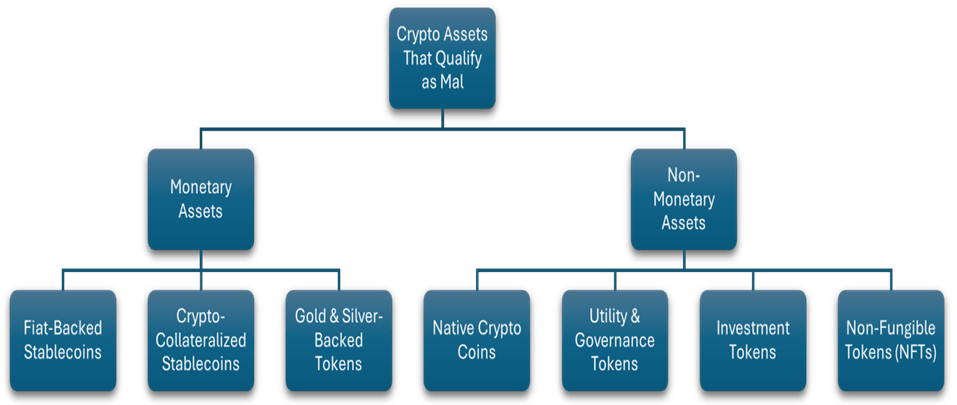
Figure 1. The SCCF’s first dividing line: money or not money
D. The SCCF at a Glance
Monetary Tokens consist mainly of 3 types:
- Fiat-backed stable coins, such as USDT and USDC, represent a fiat currency, so they are money.
- Crypto-collateralized stable coins, such as DAI (now USDS) and USDe, are money by custom, because their dominant use is as a dollar substitute.
- Gold and silver tokens, such as PAXG and XAUT, are money by nature, provided they are genuinely backed by specific physical gold and silver reserves.
On the non-monetary assets side sit four categories:
D. The SCCF at a Glance
Monetary Tokens consist mainly of 3 types:
- Fiat-backed stable coins, such as USDT and USDC, represent a fiat currency, so they are money.
- Crypto-collateralized stable coins, such as DAI (now USDS) and USDe, are money by custom, because their dominant use is as a dollar substitute.
- Gold and silver tokens, such as PAXG and XAUT, are money by nature, provided they are genuinely backed by specific physical gold and silver reserves.
On the non-monetary assets side sit four categories:
- Native crypto coins, such as BTC, ETH, and SOL, are valuable assets treated like tangible goods or digital commodities. They follow ordinary sale rules, with ownership recorded on-chain. [4]
- Utility and governance tokens. A utility token, such as LINK or RENDER, gives a right to use a service, which makes it a benefit (manfa’ah). A governance token, such as UNI or AAVE, gives a right to take part in a protocol’s decisions, which makes it a right (haqq), so the conditions for trading rights set out in Part 4 apply.
- Investment tokens come in two kinds. For tokenized real-world assets, the structure decides the type: direct ownership of an asset, company shares, debt, fund units, or sukuk according to their contract. Crypto-backed tokens, such as liquid staking and lending-pool tokens, are claims on a position, and the source of their yield must be checked.
- NFTs are treated as a tangible asset when they represent an object, and as a right when they represent access, such as a ticket, a membership, or a domain name.
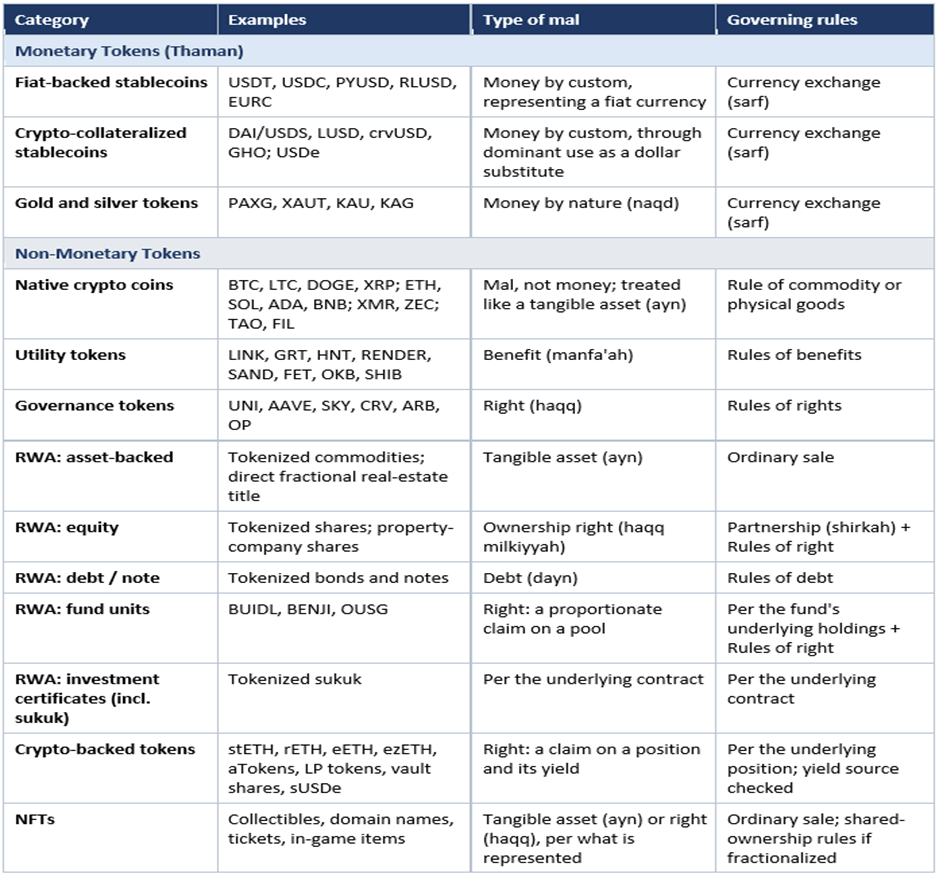
Two groups fall outside the framework. Tokens that represent nothing and are traded only on hype are not mal at all, because they offer no real benefit, and mal requires one. [5] Central bank digital currencies (CBDCs) are simply fiat money in digital form. As for meme coins, “meme coin” is a market label, not a Shariah category; each one is classified by what it actually is today. The table below puts the complete framework on record, with each category’s type of mal and the body of rules that governs it.
E. The Principles Behind the SCCF
Four principles hold the framework together.
- True nature governs, not labels. What an asset actually is and does decides its class, not just its name, its marketing, or its regulatory designation. A gold token is money even when it is sold as a commodity.
- Classification comes before permissibility. The SCCF tells you which body of Fiqh rules applies to an asset. Whether the asset, or a particular transaction in it, is halal or haram is a further analysis of its underlying value, its structure, and the facts of the case.
- Classification can change. If an asset’s dominant use genuinely shifts, it is reclassified. If Bitcoin became mainly used for everyday payments, for example, it could move to the monetary token side. The assessment applies to the asset as a whole, based on evidence, not transaction by transaction.
- An asset must first be mal. Only assets with genuine, general value enter the framework. A token with nothing behind it stays outside, and is let in only if its substance genuinely changes.
Three further rules settle the harder cases.
- Where an asset is genuinely both money-like and non-money-like, its dominant character decides;
- If that is unclear, the stricter currency rules apply as a precaution;
- Wrapped tokens, such as WBTC, take the class of what they represent if their backing is verified; and central bank digital currencies (CBDCs) fall outside the framework.
F. What the SCCF Does Not Do, and What Comes Next
The SCCF does not declare any coin or token halal or haram. It identifies the Fiqh rules that apply; applying them is the next step. Knowing that a stablecoin is money tells you that the rules of sarf govern its exchange. It does not yet tell you whether a particular stablecoin, or a particular swap, meets those rules.
Later parts of this series take each category in turn, with its Shariah rulings and conditions. Part 6 takes up the first and most debated question the framework raises: is crypto money in Shariah?
Table 1. SCCF summary classification
Sources
[1] al-Mabsut lil-Sarakhsi, vol. 14, p. 25; Ibn Abidin, Tanbih al-Ruqud fi Masa’il al-Nuqud, in Majmu’at Rasa’il Ibn Abidin, vol. 2, pp. 60–62. Gold and silver keep their status as money even if people stop using them as coins; fulus lose it once they stop circulating.
[2] Ibn Abidin, Tanbih al-Ruqud, vol. 2, p. 60. A coin counts as out of circulation only when people stop dealing in it in all lands; if it still circulates in some, it remains money there. The test the jurists applied was circulation, not the authority behind the coin.
[3] Sahih Muslim, no. 1587, from Ubadah ibn al-Samit (رضي الله عنه), from the Prophet ﷺ: gold for gold and silver for silver, like for like, hand to hand. Where both sides are the same currency, the amounts must also be equal. How these rules apply to stablecoin swaps is taken up in a later part.
[4] A similar position is taken by the Higher Shari’ah Authority of the Central Bank of the UAE, Resolution No. 217/10/2025 (11 November 2025), and by the Shariah Advisory Council of the Securities Commission Malaysia (233rd and 234th meetings, 2020).
[5] Mufti Muhammad Taqi Usmani, Fiqh al-Buyu, vol. 1, p. 27 (Maktaba Ma’arif al-Qur’an, Karachi, 2015): what human nature inclines toward, in the definition of mal, means that it is beneficial; whatever has no benefit is not mal and cannot be sold.
Categories: Articles on Islamic Finance

