

| Edited by Muhammad Ahmadullah Siddiqi and Imtiaz Yusuf |
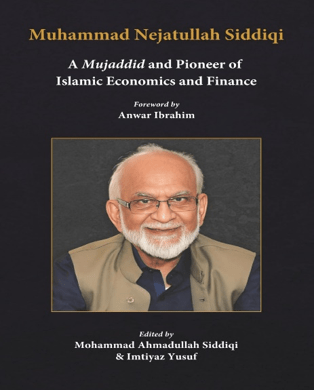
This edited book celebrates the immense contributions of Dr. Muhammad Nejatullah Siddiqi by scholars and colleagues who had massively benefited from his works and who have had the opportunity to work alongside him and take inspiration from his scholarship.
The book discusses the vast contributions of Dr. Muhammad Nejatullah Siddiqi in disciplines like economics, finance, Islamization, Maqasid-e-Shar’iah and contemporary socio-political and economic issues.
As one of the chief contributors in Islamic economics, Dr. Nejatullah Siddiqi firmly believed that Islamization, or the acquisition of knowledge, should not be pursued for the sake of gaining power and authority. Instead, the creation, acquisition, and utilization of knowledge are fundamentally intended for the betterment of humanity. Its goal is not the universal domination of Muslims, but rather the overall welfare of humanity as a whole.
In a constantly changing world, knowledge must be continually refreshed and refined to remain relevant and aligned with the expanding objectives and scope of authority. Dr. Nejatullah Siddiqi emphasized that the scope and nature of ‘ilm (knowledge) have evolved so drastically that seeking solutions to contemporary issues through outdated knowledge is akin to living in a bygone era. Indeed, it is clear that such a backward-looking approach is destined to fail.
Given the intrinsic complexity of modern challenges, direct interactions with experts are essential for understanding contemporary issues. Problems arising from global actions and their far-reaching impacts require broad, global interactions among stakeholders, concerned groups, and communities.
In light of this, Dr. Nejatullah recommended that the ‘ulama’ must broaden their thinking and explicitly acknowledge that many others possess a superior understanding of the modern world. They should willingly embrace differences of opinion, actively listen to others, and constructively engage in discussions.
Dr. Nejatullah Siddiqi’s views gradually evolved from Sayyid Abul A’la Maududi’s deeply influential thoughts regarding total Islamic change. While both scholars placed immense value on a dynamic Islamic worldview, Dr. Nejatullah Siddiqi believed that comprehensive change would remain elusive until the strength of the Islamic worldview was demonstrated both in the realms of knowledge and intellectual domains, and began to show its tangible potential in solving global human problems.
Dr. Nejatullah Siddiqi observed that Islamic economics had inadvertently become restricted to two primary aspects:
1. The prohibition of interest (Riba).
2. The imposition of Zakat (compulsory alms-giving).
He vigorously argued that the scope of Islamic economics is far broader, directly addressing a wide range of economic and social challenges and dilemmas. Furthermore, he emphasized that Islamic economics should not be limited strictly to the behavior of Muslims alone, but must also consider the behavior of all participants in the economy. In doing so, the discipline can draw upon the rich guidance provided comprehensively by the Qur’an and Sunnah.
Dr. Siddiqi firmly believes and confidently declares that the capitalism model has failed. Its failure stems from the fact that it does not give importance to fostering, rearing, support, and individual dignity. Progress alone is fundamentally insufficient to meet human needs; instead, society requires an environment that sustains a high standard of living and actively enhances it.
Essential requirements of human life include:
- Care for life’s necessities, freedom of choice, and fundamental rights (the absence of which renders life meaningless).
- Protection from exploitation and tyranny.
- The preservation of peace and justice as matters of the utmost necessity.
Unchecked economic progress often leads directly to inequality, deprivation, discord, and social disturbance.
Dr. Siddiqi highlighted that approximately two hundred years ago, a project was launched to free economics from moral values and social objectives, attempting to transform it into a purely objective science akin to physics. However, being inherently unnatural, this project failed miserably.
What the proponents failed to realize was that mathematical hypotheses frequently affect human life in profound ways. This new economics gave moral approval and sanctity to capitalism, intensified colonial expansion, and ultimately generated conflict of interests that led directly to the outbreak of two World Wars. After immense damage and destruction, society decided to put the brakes on market forces, giving birth to the idea of the welfare state. However, Prof. Siddiqi noted that the welfare state, too, would die its natural death under the weight of its own internal weaknesses. Today, while the world has apparently achieved tremendous economic development, inequitable distribution of wealth has simultaneously increased at both the national and international levels.
The narrow attitude of profit maximization centered purely on personal gain makes a person careless about the interests of their fellow man, often leading them to trample those interests entirely. From its very origin, Islamic economics has stood firmly against the concept that man is merely a slave to his self-interest.
In contrast, moral values like truth, honesty, justice, equality, and compassion teach individuals to actively care for the welfare of others alongside their own interests. People guided by values and balanced interests care about other human beings. Their framework of life teaches them to speak the truth, borrow with the strict intention to repay, and willingly give a portion of their wealth to the poor, weak, and helpless. Instead of viewing other human beings as mere means to fulfill personal goals, they consider establishing good relations with human beings as the ultimate goal itself.
It is an established fact that moral and spiritual values guide man according to the core requirements of his nature. Essential questions like when? how far? and why? require rigorous, researched answers. However, the specific research required to study the effects of moral values on the economic behavior of a person—a human being full of will and authority—cannot be expected from the neoclassical economics that has dominated the world. The academic atmosphere in which modern economics grew explicitly declared moral values to be outside its scope of research. Due to this unrealistic attitude, humanity has suffered immensely.
Because this narrow scientific position is heavily entrenched alongside the massive individual and national interests of capitalists, the foundations for liberating the West from its grip must be constructed entirely outside the realm of Western concepts. This critical task falls directly upon the servants of Islamic economics.
Dr. Siddiqi vigorously argued for the possibility of profit and loss sharing as the true essence of Islamic finance. As early as the mid-1960s, he presented a compelling theoretical argument that equity-based banking and investment banking operating entirely without interest were fully feasible. His seminal work, ‘Banking Without Interest’, carried authoritative insights into the practical and theoretical application of Mudarabah as a viable alternative to modern commercial banking.
He highlighted three primary factors that contributed significantly to the rapid progress and adoption of Islamic finance:
1. Deep-seated deficiencies in conventional financial systems.
2. The broader social and cultural resurgence within Islamic societies.
3. The strong, underlying moral orientation of Islamic finance.
In a hard-hitting but honest critique of some aspects of his own early contributions, Dr. Nejatullah Siddiqi asserted that by relying on fiqh (jurisprudence) alone, Islamic finance has inadvertently reinvented capitalism, albeit under an Islamic guise.
Distancing Sukuk from debt mechanisms is absolutely necessary to ensure they remain completely free of Riba (interest) and elements of Maysir (gambling). Dr. Siddiqi argued that this can be achieved by ensuring that Sukuk are strictly based on real assets, to the explicit exclusion of Murabaha receivables.
Similarly, Tawarruq, as a debt-creating instrument, is not linked to productive capacity and inherently leads to unlimited debt accumulation. The widespread adoption of Tawarruq as a mainstream Islamic financial product risks imposing excessive debt burdens on individuals and society at large. This trajectory not only directly contradicts the fundamental Shari’ah objective (Maqasid) of wealth preservation, but also actively undermines human life, dignity, religion, and the well-being of future generations.
Therefore, while strict legal principles are useful to help distinguish Halal (permissible) from Haram (impermissible), comprehensive economic reasoning paired with the overarching Maqasid al-Shari’ah are essential for selecting the most beneficial economic options for society.
In a nutshell, Dr. Siddiqi’s thoughts recommended these holistic reforms in the socio-economic discourse and policy.
- Family rather than market as a starting point in economic analysis
- Cooperation playing a greater role than competition in the economy
- Debts playing a subsidiary rather than the dominant role in financial markets
- Interest and interest-bearing instruments playing no role in money creation and monetary management
- Maqasid-based thinking supplanting analogical reasoning in Islamic economic jurisprudence.
Categories: Articles on Islamic Economics

