

Tariqullah Khan, CEO and Principal Economist, Ventureethica, Toronto, Canada |Formerly Professor, Hamad Bin Khalifa University (HBKU), Qatar; INCEIF University, Malaysia; Istanbul Sabahattin Zaim University, Türkiye; Visiting Scholar, Harvard University and Stanford University; former Division Chief, Islamic Finance, IsDB Institute |Correspondence: tariqullah.khan@ventureethica.com | May 2026
The methodological debate in Islamic economics has long been framed as a choice between two incomplete programmes: an assimilative approach that folds revealed values into the mainstream apparatus by pricing religiosity as one good among others, and a distinctive approach that rejects neoclassical tools wholesale in favour of a separate analytical idiom.
Shaikh (2026) advances the discipline by refusing this binary. His integrative methodology argues for methodological pluralism – admitting both behaviour in markets, where refined marginal analysis remains serviceable within the Halāl choice set, and behaviour beyond markets, where faith-motivated action must not be economised – under a single disciplinary roof. Grounding the move empirically in World Values Survey data, which reveal only modest divergence between Muslim and non-Muslim respondents on universal morality and market attitudes, he licenses the integrative path over the separatist one and offers, in the budget-only treatment of charitable spending, a disciplined device for keeping the moral motive analytically pure.
Yet, Shaikh achieves integration of scope by partitioning method: he houses the two domains together while keeping their tools strictly apart, and the seam shows wherever a single decision carries mixed motives. The present extension completes the integration by coordinatising what Shaikh (2026) segregates. Drawing on Dynamic Prescriptive Islamic Economics (Khan, 2026), it renders his one-dimensional fork as a two-dimensional decision field – an economic axis and an irreducible normative axis – governed by two axioms, irreducibility and non-substitutability, and ordered by two screens, the Sharīʿah gate followed by the continuous Tayyib index τ.
On this construction, the assimilative, distinctive, and integrative postures occupy distinct quadrants, and the integrative corner ceases to be merely the preferred middle: it becomes the unique admissible archetype, the only one able to locate the destination v* = (1, 1) and to measure, through the d-gap, an actor’s dynamic progress toward it. What Shaikh (2026) secures by separating spheres, DPIE secures by a single metric over one field.
1. The Methodological Plane
Integration, in the sense Shaikh (2026) seeks, requires a single space in which the two kinds of conduct he distinguishes – economic behaviour within the market [e] and normatively-motivated behaviour beyond the market [n] – can be and must be located together rather than consigned to separate methods. Dynamic Prescriptive Islamic Economics supplies exactly such a space. Instead of partitioning analysis by sphere, it represents every economic position as a point in a common field defined by two questions: how well a choice, agent, firm, or institution performs on the economic dimension, and how far it stands from its normative destination. Because these two dimensions are irreducible to one another – value cannot be read off price, nor price off virtue – they are drawn as orthogonal axes, and the problem of method is recast as a problem of location: where in the field a given practice sits, and in which direction it must move to improve.
Formally, the decision field is the closed square [−1, +1]² under the standard Cartesian (Normalized Balance Coordinates) convention, with Q1 in the upper-right (e > 0, n > 0), Q2 the upper-left (e < 0, n > 0), Q3 the lower-left (e < 0, n < 0), and Q4 the lower-right (e > 0, n < 0). The horizontal axis e measures economic adequacy – the legitimate, risk-bearing value a choice creates through the market – while the vertical axis n measures normative adequacy, the choice’s attainment against the Maqāsid, scored by rubric rather than priced by exchange. The destination is the single ideal point v*= (+1, +1), Tayyib: simultaneous fullness on both dimensions. Q1 is therefore not Tayyib itself but the region approaching it – the only quadrant from which the destination is even reachable.
Two screens order admissibility. The first is the Sharīʿah filter – the binary gate (business-activity, leverage, and impure-income thresholds) that excludes the inadmissible set entirely, corresponding exactly to the axiomatic exclusion of Harām. The second is τ, the Tayyib index: a continuous measure of proximity to v* that operates only within the Halāl universe admitted by the first screen. τ partitions the admissible region into bands – Tayyib-Near (τ ≥ 0.85), High (0.70–0.85), and Transitional (0.55–0.70). The d-gap, d (x, v*), is the residual distance from an actor’s coordinate to Tayyib; the prescriptive objective is its dynamic reduction over time. The STO taxonomy classifies the source of that gap, and the STO remediation tree routes the corrective instruments – Zakāt, Awqāf, Himā, Sadaqah Jāriyah – that close it.
Rubrics supply the measurement layer. Each axis – most consequentially n – is operationalised by a structured instrument that converts Maqāsid content into a coordinate, with inter-rater divergence resolved under the Panel Consensus Protocol. Acquired Epistemic Rationality (AER), expressed through the integration function Φ (S (science), H (history), W (Wahy/Shariah/Maqasid), P (practice)), is the single rationality operating across the whole field, so the agent does not switch engines at the market boundary; its cross-civilizational grounding – wasatiyyah, sophrosyne, zhongyong – supplies the convergent normative content that the n-axis scores.
2. Two Foundational Axioms
The field’s geometry is not a modelling convenience; it rests on two axioms governing the relationship between the economic axis e and the normative axis n. Together they determine why the plane must be two-dimensional and why its admissible region is gated rather than smoothly traversable.
Axiom A1 – Irreducibility. The economic and normative axes are mutually irreducible: there exists no function f such that n = f(e), and none such that e = f(n), across the admissible domain.
Normative adequacy cannot be derived from, or restated as, economic value, and economic adequacy cannot be derived from normative standing. Price encodes exchange value, not Maqāsid attainment; the preservation of dīn, nafs, ʿaql, nasl, and māl has no market-clearing representation. Consequently, v* = (1, 1) is reachable by optimising neither axis alone, and a methodology confined to one axis is structurally incapable of locating Tayyib. This is the formal statement of the market’s failure at public goods, externalities, and distributive justice: confined to e, the market cannot close a d-gap that lies along n.
Axiom A2 – non-substitutability. The two axes are non-compensatory below the τ-floor τ_min: for any actor whose normative coordinate falls short of the floor, no increment on the economic axis restores admissibility. The ordering is lexicographic — the Sharīʿah gate and the τ-floor are satisfied first, and economic optimisation proceeds only within the floor-admissible set. Formally, where n < τ_min, no Δe > 0 yields admissibility, and the marginal rate of substitution between e and n is undefined rather than merely steep. Ribā-laden profit cannot be repurchased by efficiency; the warm-glow donor cannot substitute private satisfaction for genuine movement toward v*.
Compensation logic – the premise that everything bears a price and trades at some MRS – is precisely the atomistic ontology the framework rejects.
The two axioms are independent. A1 concerns the dimensionality of the field (two axes, neither collapsible); A2 concerns its traversability (the axes cannot be traded across the floor). A framework could in principle accept one and deny the other, and the four archetypes are distinguished precisely by which axioms they honour.
| Axiom | Statement | What it governs / defeats |
| A1 — Irreducibility | No function maps n = f(e) or e = f(n) across the admissible domain; v* = (1, 1) is unreachable by optimising either axis alone. | Fixes the dimensionality of the field (two axes, neither collapsible); defeats the assimilative reduction of the sacred to price. |
| A2 — Non- Substitutability | Below the τ-floor τ_min the axes are non- compensatory: no Δe > 0 restores admissibility once n < τ_min; ordering is lexicographic; the MRS between e and n is undefined, not merely steep. | Fixes the traversability of the field (gated, not graded from anywhere); defeats the compensation / MRS logic of atomistic exchange. |
3. The Four Quadrant Archetypes
Each methodology is characterised by how it treats the two axioms, and the four treatments map onto the quadrants of the meta-plane whose axes are assimilation (the appropriateness of mainstream-analytical deployment) and distinction (the appropriateness of preserved Islamic distinctiveness).
This meta-plane is homologous to the substantive field: an assimilative posture is the methodological image of reducing n to e; a distinctive posture is the image of denying e; and the integrative posture is the image of honouring both axioms at once. Orientation matters — each axis runs from inappropriate (−1) to appropriately deployed (+1), so that more is not better in the raw, and only the joint, domain-disciplined corner is ideal.
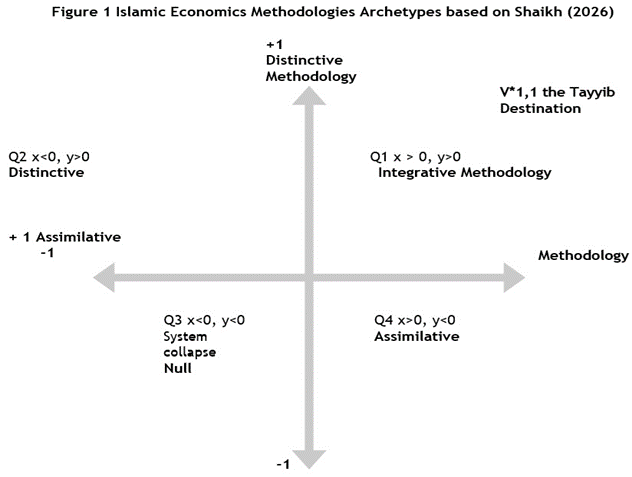
| Archetype (Quadrant) | Defining posture | Representative case | Axiom status / failure mode |
| Integrative Q1 (+, +) | Mainstream tools well- deployed on the economic axis; distinctiveness preserved on the normative axis; clears the gate, then optimises within it. | Shaikh’s stated aspiration; completed by DPIE. | Honours A1 and A2 — the unique admissible archetype; locates v*. |
| Assimilative Q4 (+, −) Failure mode | Economic axis honoured; normative axis priced away and allowed to collapse. | Divine economics; the economics-of- religion programme. | Violates A1 (reduces n to e); economises religion. |
| Distinctive Q2 (−, +) Failure mode | Normative axis asserted; mainstream analytical tools refused any purchase. | Separatist school — Siddiqi’s “beyond rhetoric” target. | Violates A1 (collapses field onto n); loses analytical traction. |
| Null Q3 (−, −) Failure mode | Neither a working economic apparatus nor a coherent normative metric. | Pre-analytical exhortation. | Violates A1 and A2; rhetoric without measurement or traction. |
Q1 – Integrative (v*). Signature (+, +): mainstream tools well-deployed on the economic axis and distinctiveness appropriately preserved on the normative axis. The integrative archetype honours both axioms – it accepts irreducibility by maintaining a distinct, separately scored n-axis rather than pricing the normative, and it accepts non-substitutability by clearing the Sharīʿah gate and τ-floor before it optimises. This is the methodological wasatiyyah: the only archetype that can locate v*, and the only one admissible under both axioms. Shaikh’s (2026) integrative method aspires to this corner but reaches it by partitioning method across spheres rather than by coordinatising a single field; DPIE supplies the metric the corner requires.
Q4 – Assimilative. Signature (+, −): the economic axis is honoured while the normative axis is allowed to collapse. The assimilative archetype violates A1: it reduces n to e by treating religion as one priced good among others, recovering normative content only as a market quantity. Because it denies the second axis it cannot represent a d-gap lying along n, and it economises religion rather than Islamising economics. It is internally coherent and analytically powerful — which is precisely what makes it the most seductive of the failures.
Q2 – Distinctive. Signature (−, +): the normative axis is asserted while the economic axis is rejected. The distinctive, separatist archetype mirrors the assimilative error: it collapses the field onto n by refusing mainstream analytical tools any purchase, and so it too violates A1, in the opposite direction. It preserves moral seriousness at the cost of analytical traction — the position Siddiqi warns against in calling for a framework that moves beyond rhetoric.
Q3 – Null. Signature (−, −): neither axis is attained. The null archetype has neither a working economic apparatus nor a coherent normative metric – pre-analytical exhortation that violates both axioms by attaining neither. It is the residual into which both purist programmes decay when they fail to deliver: rhetoric without measurement and without market traction.
4. Q1 as the Unique Admissible Archetype
Under the two DPIE axioms, integration is not merely preferred but is the only admissible archetype (Q1), while the others are formal failure modes. The axioms render the ranking strict rather than merely preferential. A1 eliminates Q4 and Q2, each of which survives only by collapsing the irreducible field onto a single axis. A2 then explains why no actor can migrate from Q4 to Q1 by accumulating economic value: the τ-floor cannot be purchased, so it must be cleared on the normative axis directly. Q3 fails both axioms trivially. Q1 alone honours irreducibility (it keeps two scored axes) and non-substitutability (it gates before it grades). The four-fold typology is therefore not a menu of equally respectable options but a single admissible corner surrounded by three characteristic failures – one that prices the sacred, one that abandons the analytical, and one that does neither.
This also resolves a latent ambiguity in the meta-plane. The integrative corner is admissible not because it maximises both postures indiscriminately – that would be incoherent eclecticism – but because the two axioms supply the domain discipline: mainstream tools are deployed where the economic axis governs, distinctiveness is preserved where the normative axis governs, and the τ-floor forbids trading one for the other. The partition that Shaikh (2026) leaves implicit in his prose is, on this account, a theorem of the two axioms rather than a methodological stipulation.
5. Analysis
Shaikh’s (2026) integrative methodology (although in fact, integration by segregation) can be located within the DPIE plane as a movement from methodological partition toward coordinated integration. His central contribution is to reject both extremes: the assimilative programme, which absorbs Islamic values into mainstream economics by treating religion as another market preference, and the distinctive programme, which rejects mainstream analytical tools altogether. Instead, Shaikh (2026) argues that marginal analysis remains useful within the Halāl market sphere, while non-market, faith- motivated conduct must retain its moral distinctiveness.
In DPIE terms, this places Shaikh’s (2026) project on the path toward Q1: the quadrant where economic adequacy and normative adequacy are both preserved. The economic axis, e, captures legitimate market value, efficiency, incentives, and exchange behaviour. The normative axis, n, captures Maqāsid, Sharīʿah purpose, moral intentionality, justice, and ecological-social responsibility. Shaikh’s (2026) framework recognises both axes, but it still tends to separate them by sphere. DPIE completes the move by placing them within one methodological plane.
The mapping is therefore as follows. Shaikh’s (2026) critique of atomistic individualism, market failure, public goods, externalities, and intergenerational discounting exposes the insufficiency of e-only optimisation. His treatment of responsibility, humility, simplicity, and revealed values affirms the necessity of a separate n-axis. His discussion of Halāl market segments remains valid in the Q1 interior, where permitted goods and services may still be analysed through prices, income effects, substitution effects, and elasticity. However, his rejection of economising altruism, religion, and moral motivation confirms the non-substitutability of n by e.
His World Values Survey evidence supports the admissibility of integration: Muslims and non- Muslims show modest divergence on market attitudes and broadly shared moral commitments. This strengthens the case for a common n-axis scored through rubrics rather than prices. His budget-only treatment of charity is especially important: it protects altruistic intention from being absorbed into utility as “warm glow.” DPIE reads this as a practical affirmation that moral movement must occur on the normative axis directly, not through economic compensation.
DPIE Interpretation of Shaikh’s (2026) Findings
- The evidence rejects the narrow Homo Economicus assumption. Both Muslims and non- Muslims display concern for responsibility, good manners, fairness, family well-being, and social interest alongside economic self-interest. Human behaviour appears multidimensional rather than purely utility-maximizing.
- The data supports the existence of a normative dimension distinct from the economic dimension. The persistence of moral attitudes across populations suggests that values cannot be fully explained by prices, incentives, or market exchange alone. This is consistent with the DPIE principle of irreducibility.
- Muslims and non-Muslims appear closer than many Islamic economics debates assume. While religiosity differs substantially, attitudes toward morality, markets, competition, and social concern are broadly similar. The findings point toward a shared human normative field rather than sharply divided economic worldviews.
- The data supports an integrative rather than a separatist approach to Islamic economics. Since both groups accept market incentives while simultaneously valuing moral conduct, the challenge is not choosing between markets and values but coordinating both within a common framework.
- The central sustainability problem appears institutional rather than moral. Shaikh (2026) documents climate change, inequality, waste, and environmental degradation despite widespread moral commitments. The implication is that positive values are not being adequately translated into institutions, incentives, technologies, and governance systems.
- From a DPIE perspective, the findings justify a two-dimensional framework. The survey provides strong support for analysing economic adequacy and normative adequacy simultaneously, even though it does not yet validate specific DPIE constructs such as τ, d- gap, or STO effectiveness.
The strongest message from Shaikh’s (2026) data is the evidence that people generally possess or at least recognize both economic and moral motivations – the DPIE foundational axioms: the irreducibility and non-substitutability of Akhira and Dunya. The challenge of sustainability and Islamic economics is therefore not the creation of values, but the design of decision systems and institutions that can align economic performance with normative objectives.
Shaikh’s (2026) mathematical models of consumption externalities, production externalities, public goods, Zakāt, Waqf, patience, risk aversion, and intertemporal choice operate most coherently in the admissible Q1 interior. In this region, mainstream tools remain useful after the Sharīʿah gate has been cleared. But as the actor moves closer to the Tayyib destination v* = (1,1), substitution between e and n becomes less acceptable. The elasticity of substitution declines, and the geometry moves from Cobb-Douglas-style trade-off toward Leontief-style complementarity.
Thus, Shaikh’s contribution is best read not as a complete replacement of mainstream economics, nor as a full Islamisation of economics by assertion, but as an integrative bridge. DPIE formalises that bridge. The Sharīʿah gate first excludes the inadmissible. The Tayyib index τ then measures proximity to v* within the Halāl domain. The d-gap identifies the remaining distance from the ideal. STOs then prescribe corrective movement through substitutions, transformations, and offsets.
In summary, Shaikh preserves the mainstream apparatus where it works: the economic interior of the Halāl set. DPIE extends his insight by showing where that apparatus must stop: at the point where normative adequacy, Maqāsid, ecological responsibility, distributive justice, and moral intention become binding. The final methodological lesson is clear: integration does not mean pricing values; it means coordinating economic and normative dimensions without reducing either to the other.
The shape of isoquants will be different under the different archetypes. Within the relevant Q1 for example, at v 0.2, 0.2 the MRS may be on different isoquant as compared to L shape approaching 1,1. This consideration is important for several reasons:
- It formalises the domain of applicability of mainstream tools. At v = (0.2, 0.2), the agent is far from the Tayyib destination 1,1. The isoquants are smooth, substitutable (Cobb-Douglas style), and a well-defined MRS exists. This means within the low-attainment region, neoclassical marginal analysis (prices, substitution effects, optimisation) is perfectly appropriate. Shaikh’s (2026) claim that refined mainstream tools work in the Halal market interior is exactly captured by this geometry. At v → (1,1), the isoquants become L-shaped (Leontief), the MRS is undefined (or infinite/zero depending on direction), and substitution is no longer possible. This corresponds to Shaikh’s (2026) insistence that beyond-market, faith-driven choices cannot be economised or traded off. The geometry shows that the same agent moving toward the ideal must eventually switch behavioural logic – but the DPIE framework encodes that switch as a continuous deformation of the isoquant family, not as a segregation of toolkits.
- It solves the “Seam” problem of integration by segregation. Shaikh (2026) keeps market and beyond-market analysis separate because he has no way to represent a smooth transition. In his framework, an agent is either in the market (using MRS) or beyond it (no MRS). The DPIE plane shows that the MRS is not a binary on/off but a function of proximity to the ideal, i.e., MRS = f(τ) with f(τ) → undefined as τ → 1. Thus, the same agent can gradually reduce her reliance on substitution as she progresses. This eliminates the need for segregation.
- It has empirical and policy implications. If we measure an agent’s current τ (e.g., a firm’s compliance with Maqāsid), we know whether marginal incentives (prices, taxes, subsidies) will be effective. At low τ, price signals work. At high τ, only non-compensatory, normative instruments (e.g., prohibitions, clear gatekeeping) work. Policy can therefore be dynamic: start with market-based tools for laggards, then switch to moral suasion or Shari’ah gates as agents approach the ideal. This is impossible under Shaikh’s segregated framework.
The difference in isoquant shape is not a minor technical detail; it is the geometric signature of the axioms of irreducibility and non-substitutability. It shows that the same decision field can host both substitutable and non-substitutable regions, thereby completing the integration that Shaikh leaves incomplete.
6. Conclusion
The methodological contribution of Shaikh (2026) is to formulate, more sharply than most of the literature, the choice between an assimilative economics that prices the sacred and a distinctive economics that abandons the analytical, and to argue – on the strength of World Values Survey evidence of broadly shared moral and market attitudes – that the discipline should occupy neither pole but an integrative middle. That diagnosis is sound, and the integrative impulse is the correct one. Its limitation is structural rather than substantive: Shaikh (2026) integrates the scope of analysis while partitioning its method, housing market and beyond-market behaviour under one disciplinary roof but assigning each its own separate toolkit. The result is integration by segregation, a one- dimensional fork resolved by keeping the two domains apart, and the seam shows wherever a single decision carries mixed motives.
Framed through Dynamic Prescriptive Islamic Economics (Khan, 2026), the same integrative impulse is carried to its formal conclusion. What Shaikh (2026) proposes as a methodological posture, DPIE renders as an operational field: a two-dimensional decision space ordered by two screens – the Sharīʿah gate followed by the continuous Tayyib index τ – governed by the axioms of irreducibility and non-substitutability, and oriented, through the d-gap, toward the single destination v* = (1, 1).
Integration here is not a pluralism of tools held side by side but the coordinatisation of one space, and the integrative position ceases to be merely the preferred middle: it becomes the unique admissible archetype, the only quadrant from which Tayyib can be reached and against which progress can be measured. This completes rather than corrects Shaikh (2026); his independent contributions – the empirical grounding, the Kantian critique of warm-glow, the reclassification of needs by elasticity – stand on their own.
The analytical gain is visible in the very apparatus Shaikh (2026) relies upon. His marginal rate of substitution and elasticity machinery are not discarded but located: smooth, everywhere-defined substitution of the Cobb-Douglas type (σ ≈ 1) holds in the substitutable interior of the Halāl set, far from the destination, exactly as he uses it. As attainment rises toward Tayyib, however, the elasticity of substitution falls – σ(τ) → 0 – and the isoquant family deforms continuously from Cobb-Douglas toward Leontief, its kink riding the ray to v*.
At the corner, the marginal rate of substitution between the economic and normative coordinates is not merely steep but undefined: the geometric signature of non-substitutability, and the precise formalisation of Shaikh’s (2026) own reading of convexity as a preference for balance, or Wasatiyyah. His framework, in short, already gestures toward the result; DPIE supplies the metric that makes it exact. Both accounts must remain modest about the underlying evidence, which establishes that values are widely shared rather than that the normative attractor is invariant – a question the framework leaves open for the cross-country work it now makes possible.
References
Khan, T (2026). Dynamic Prescriptive Islamic Economics. Ventureethica. https://www.tariqullah.com/dynamic-prescriptive-islamic-economics
Shaikh, Salman Ahmed. (2026). Journal of Muamalat and Islamic Finance Research. Vol. 23, No. 1, June 2026, Pp. 22-42. DOI: https://doi.org/10.33102/jmifr.648
Categories: Articles on Islamic Economics

